WARNING: Mushroom foraging is an inherently dangerous activity. Consuming wild fungi can lead to irreversible organ failure, severe illness, or death. This digital asset serves strictly as an educational reference framework. Variations in climate, forest soil chemistry, and fungi maturity stages can distort physical characteristics. By interacting with this data, the user explicitly assumes all physiological risks and agrees to hold the creator, author, and developer completely harmless from any legal actions, claims, damages, or medical liabilities arising from foraging activities.
Universal Safety Protocols
- 1. The 100% Rule A mushroom must perfectly fulfill every listed botanical marker (veil presence, gill connection, spore print, stem structure). If even one feature is ambiguous, discard it.
- 2. The Sub-Surface Inspection Always dig beneath the soil or moss layer to inspect the absolute base of the stalk. Cutting a stem at the surface can leave behind a deadly Amanita volva (sac), leading to a fatal mistake.
- 3. The Cross-Section Split Always cut a specimen exactly in half vertically. This reveals hidden gills in "button stages" or chambered cavities in false morels.
- 4. Spore Print Verification Never consume an advanced gilled mushroom without validating its spore print color on high-contrast paper.
- 5. Tree Alliance Check Always look up and identify the surrounding trees. Many choice northern species are obligate symbiotic partners with specific boreal trees.
Spore Printing Instructions
- Carefully slice the stalk completely off the cap using a sharp blade.
- Place the cap with the gill/pore side facing down onto a card that is half-white and half-black.
- Place a single drop of clean water on top of the mushroom cap to stimulate moisture release.
- Cover the cap completely with a glass bowl or cup to eliminate cross-drafts.
- Leave undisturbed for 6 to 12 hours, then evaluate the true color of the residual dust path under natural daylight.
Emergency Contacts
| Contact | Number | Notes |
|---|---|---|
| Upstate New York Poison Center | 1-800-222-1222 | Call immediately if ingestion is suspected. Do not wait for symptoms to manifest. Keep an intact specimen or high-quality photos of the mushroom consumed. |
| Adirondack Regional Hospital (Saranac Lake ER) | 1-518-891-3000 | 223 Church St, Saranac Lake, NY 12983 |
| Glens Falls Hospital ER (Southern Adirondack Access) | 1-518-926-1000 | 100 Park St, Glens Falls, NY 12801 |
| NYS Department of Environmental Conservation (DEC) Rangers | 1-518-408-5850 | Call for back-country emergency rescues or trail accidents within the Adirondack Park. |
Edible Species & Their Dangerous Look-Alikes
Adirondack Mountains & boreal forests, New York — organized by season
Season: Spring (Late April to June) · Habitat: Hardwood valleys, rich soils, decaying apple orchard systems, near dying American Elms, White Ash, old apple trees
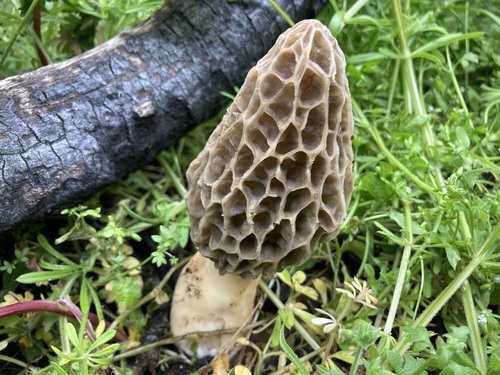
Photo: verified Morchella americana/esculenta
Yellow and Black Morels
Morchella species
- Cap: distinctly honeycombed with deep, uniform pits
- Cap-to-stem attachment: bottom ridge of cap fused directly to the stem
- Cross-section: one continuous hollow chamber from tip to root, no partitions
🍳 Cooking note: Must be cooked thoroughly for at least 15 minutes to destroy mild toxins naturally present in raw morels. Sauté in butter with garlic, or slice lengthwise, coat in flour, and pan-fry. Pairs well with cream reductions.
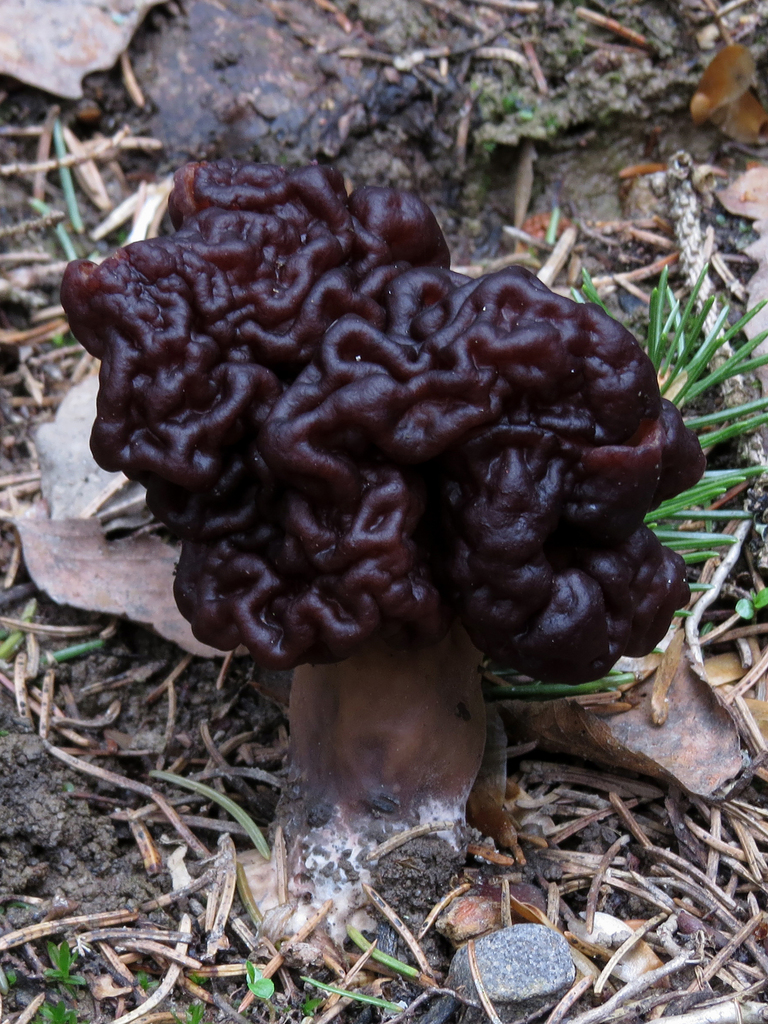
Photo: verified Gyromitra esculenta
False Morel
Gyromitra esculenta / Gyromitra species
Onset: Delayed 6-12 hours
Symptoms: Severe nausea, projectile vomiting, watery/bloody diarrhea, abdominal cramps — then dizziness, lethargy, muscle uncoordination, loss of balance, headaches — then jaundice, dark urine, liver failure, seizures, coma, death.
- Cap: convoluted, brain-like, wavy/folded rather than neatly pitted
- Cap skin folds hang free from the stalk, or attach only at the peak
- Cross-section reveals a chambered, dense, multi-pocketed or fibrous interior instead of a clean hollow chamber
- Toxin: Gyromitrin / Monomethylhydrazine (MMH)
Season: Summer to Early Autumn (July-September) · Habitat: Damp moss beds, forest paths, sloped trail drainage, near Eastern Hemlock, White Pine, American Beech, Oaks
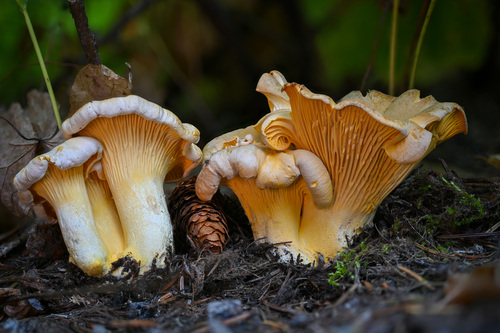
Photo: verified Cantharellus cibarius, Northeast
Golden Chanterelle
Cantharellus cibarius complex
- Bright, uniform egg-yolk-yellow to orange trumpet shape
- Underside: false gills — blunt, shallow ridges that fork naturally and can't be scraped off without tearing the flesh
- Pleasant aroma mimicking ripe apricots
- Flesh: clean, solid white, splits vertically like string cheese
🍳 Cooking note: Dry-sauté first to sweat out water, then cook with butter/oil until edges turn golden brown. Don't mask the delicate fruity flavor with heavy spices; minimal salt and pepper.

Photo: verified Omphalotus illudens
Jack-O'-Lantern Mushroom
Omphalotus illudens
Onset: Rapid, 30 minutes to 2 hours
Symptoms: Violent non-stop vomiting, intense abdominal contractions, profuse sweating, heavy salivation, teary eyes, severe diarrhea leading to dehydration.
- Grows strictly in large, tightly packed, overlapping clusters from a shared base
- Grows directly out of decaying wood stumps, dead logs, or buried roots — never loose soil
- Underside: true gills — sharp, knife-like, deep, paper-thin, do not fork
- Flesh is orange throughout the interior when broken open
Season: Late Summer (August-September) · Habitat: Boreal conifer zones, mixed high-elevation forest, near Spruce, Balsam Fir, Eastern White Pine, Birch
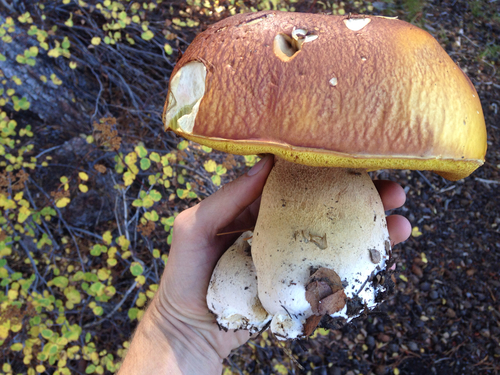
Photo: verified Boletus edulis
King Bolete / Porcini
Boletus edulis
- Large, thick, club-shaped/bulbous stem
- Cap: smooth brown, like a baked hamburger bun, slightly sticky when damp
- Top of stalk shows fine raised white web (reticulation)
- Underside: spongy pore layer (no gills), white turning olive-yellow
- Flesh does not change color when cut
🍳 Cooking note: Slice cap and stem 1/4-inch thick, sauté in hot olive oil with rosemary/thyme until caramelized. Excellent dehydrated — intensifies the nutty umami flavor.
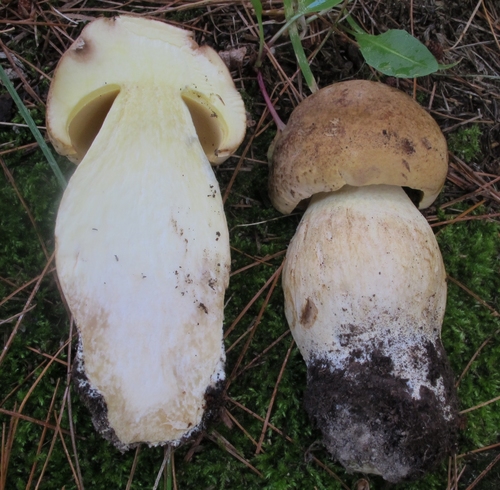
Photo: (c) mycowalt, CC BY-SA, via iNaturalist
Huron Bolete
Boletus huronensis
Onset: 1-4 hours
Symptoms: Intractable, prolonged vomiting, cold sweats, severe nausea — can require hospitalization for IV fluids.
- Pore surface is dull yellow, stains slow dirty blue-green when bruised with a thumb
- Stem reticulation yellow or absent — lacking the King Bolete's prominent white webbing
- Flesh frequently shows a slow blue stain when sliced vertically
- Toxin: uncharacterized GI irritants
Season: Late Summer to Autumn (August-October) · Habitat: Open forest clearings, grassy trail margins, leaf compost zones, saprophytic on decaying leaves/rich topsoil
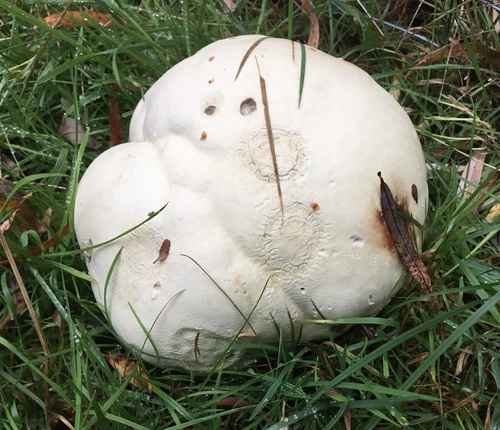
Photo: verified Calvatia gigantea
Giant Puffball & Gemmed Puffball
Calvatia gigantea / Lycoperdon perlatum
- Spherical or pear-shaped white bodies on the forest floor
- Interior core (gleba) must be perfectly uniform, solid, pure white — like fresh cream cheese
🍳 Cooking note: Peel the tough outer skin of giant puffballs, slice the pure white interior into thick slabs, dip in egg wash, coat in breadcrumbs/cornmeal, and pan-fry like tofu or eggplant. Absorbs companion flavors well.
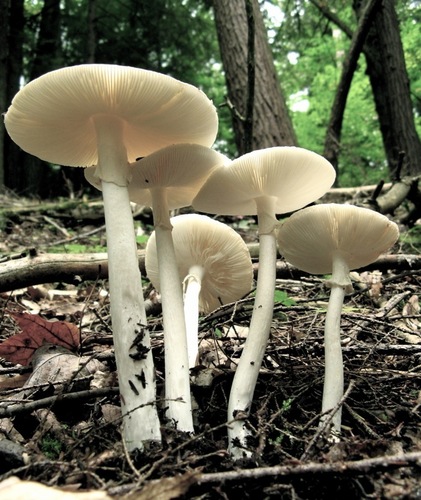
Photo: verified Amanita bisporigera, Destroying Angel
Destroying Angel (Button Stage) & Pigskin Earthball
Amanita bisporigera / Scleroderma citrinum
Onset: Amanita delayed 6-24 hours while internal damage occurs silently
Symptoms: Phase 1: violent cholera-like watery diarrhea, severe vomiting, abdominal pain. Phase 2: apparent recovery for 24 hours while liver enzymes spike. Phase 3: complete liver/kidney failure, internal bleeding, hepatic coma, organ failure, death.
- Cutting a young Amanita button vertically reveals a distinct miniature embryonic cap/stem/gills silhouette under an outer veil layer
- Earthballs are tough, hard, rubbery, thick rind-like skin
- Earthball interior core turns dark purple/deep blue/jet black almost immediately during development — never pure white like a true puffball
- Toxin: Amatoxins (Amanita) / Sclerodermine (Scleroderma)
Season: Autumn (September-November) · Habitat: Clustering directly on dead wood logs/stumps/decomposing roots of Hardwoods, Sugar Maple, Yellow Birch, American Beech
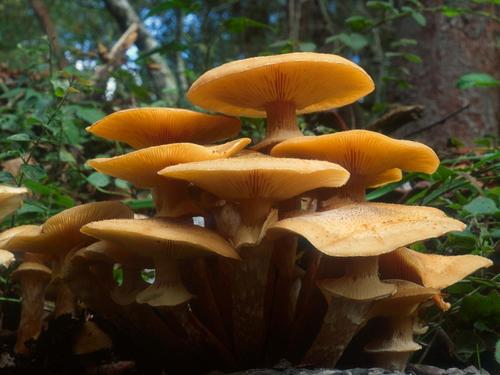
(c) Nathan Wilson, some rights reserved (CC BY-SA), via iNaturalist
Honey Mushroom
Armillaria mellea complex
- Clusters of honey-yellow to tan caps with minute hairs near the center peak
- Stalk has a prominent, persistent, white paper-like ring
- Spore print reliably pure white
🍳 Cooking note: Stems are extremely fibrous — discard, cook only caps. Must be sautéed thoroughly for 15-20 minutes, as undercooked honeys cause mild stomach upset. Great in stews and wild mushroom soups.
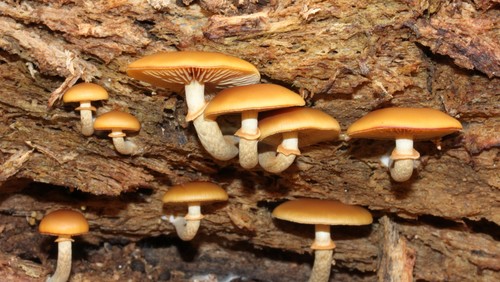
Photo: verified Galerina marginata
Deadly Galerina / Funeral Bell
Galerina marginata
Onset: Delayed 6-24 hours
Symptoms: Identical profile to Destroying Angel — delayed severe GI distress, temporary improvement, then irreversible terminal liver/kidney failure.
- Can grow intermingled on the exact same log/stump as true Honey mushrooms
- Generally smaller and more physically fragile across cap and stem
- Caps orange-brown to cinnamon-brown, turning tan when dry
- Spore print is rusty brown, coloring gills of mature specimens deep brown instead of white
- Toxin: Amatoxins
Season: Summer to Autumn (June-October) · Habitat: Living tree wounds/decaying logs, hardwood and highland conifer zones, on Oaks, Cherries, Maples (avoid Eastern Hemlock)
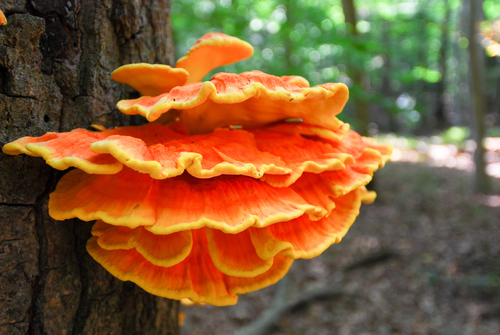
Photo: verified Laetiporus sulphureus
Chicken of the Woods
Laetiporus sulphureus
- Bright vibrant orange top skin contrasted against a sulfur-yellow underside
- No gills — microscopic pores on the underside
- Grows in large, fan-shaped, overlapping shelves on hardwoods
🍳 Cooking note: Cut into strips — texture mimics real poultry. Sauté thoroughly in butter with onions, or dredge in batter and deep-fry. Absorbs large amounts of cooking fat — keep the pan oiled.
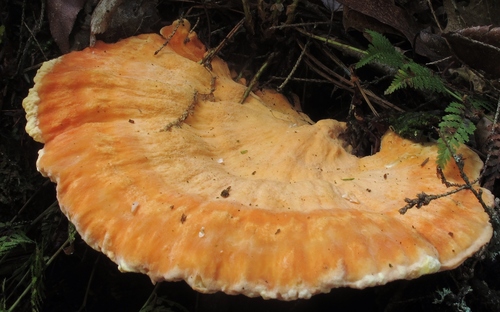
Photo: (c) mycowalt, CC BY-SA, via iNaturalist
Hemlock Chicken / Conifer Sulphur Shelf
Laetiporus huroniensis
Onset: 1-3 hours
Symptoms: Severe nausea, dizziness, visual hypersensitivity, lip swelling in sensitive individuals, gastric upset.
- Morphologically identical to the choice edible variety, but grows strictly on conifers — specifically Eastern Hemlock logs/stumps
- White pore surface rather than bright sulfur-yellow pore surface
- Toxin: absorbed conifer tree resins / localized compounds
Season: Autumn to Early Winter (September-December) · Habitat: Decaying hardwood trunks, fallen logs, dead branches, on Sugar Maple, Beech, Aspen, Willows
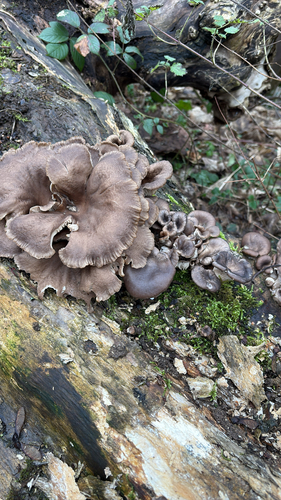
Photo: (c) iNaturalist contributor, CC BY-NC, verified Pleurotus ostreatus
True Oyster Mushroom
Pleurotus ostreatus
- Smooth, fan/shell-shaped caps, ivory-white to grey-brown
- Gills deeply decurrent, running down the off-center short stem
- Flesh thick, white, soft, faint anise/licorice scent
- Spore print white to lilac-grey
🍳 Cooking note: Sauté fast over medium-high heat with butter and tamari/soy sauce until edges brown and crispy. Cooks quickly — great in stir-fries or pasta.
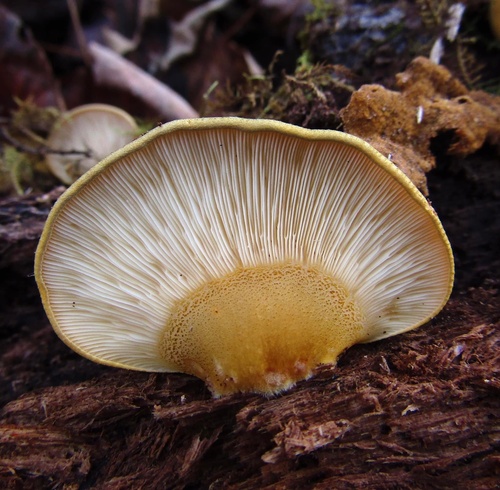
Photo: (c) garrett_brown, CC BY-NC, via iNaturalist
Late Fall Oyster / Olive Mock Oyster
Sarcomyxa serotina
Onset: Within 2 hours
Symptoms: Bitter lingering taste, mild stomach cramping, nausea, minor digestive irritation from tough fibers.
- Cap is olive-green, yellowish-green, or dark muddy-green — never the true Oyster's ivory-white/grey-brown
- Stem covered in tiny, fine, dark brownish scales or yellowish fuzz
- Flesh exceptionally tough and rubbery compared to true Oyster mushrooms
- Toxin: GI irritants (bitter compounds)
Season: Late Summer to Autumn (August-October) · Habitat: Leaf litter and mossy ground across mixed upland forests, near Hemlock, Pine, Birch, Beech
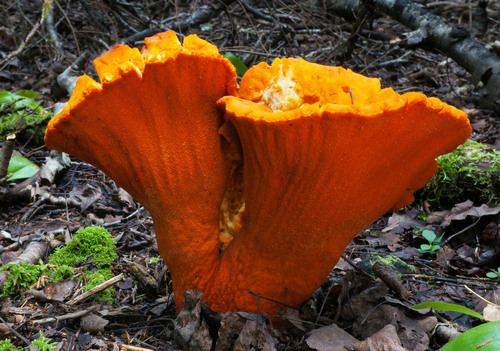
Photo (c) tombigelow, some rights reserved (CC BY-NC), via iNaturalist
Lobster Mushroom
Hypomyces lactifluorum
- Not a true mushroom — a parasitic mold colonizing host mushrooms (Lactarius or Russula)
- Transforms the host into a hard, distorted, bright orange-red crust resembling cooked lobster shell
- Surface covered in microscopic pimple-like bumps, no true gills
- Inner flesh solid, crisp, pure white
🍳 Cooking note: Dense, firm texture holds up to heavy cooking. Slice thin, pan-fry in butter/oil. Colors cooking fats light yellow-orange with a mild seafood-like undertone. Excellent in risottos.
No verified photo of a decaying specimen was available — rely on these signs instead: texture turns soft/mushy (not firm and crisp); color dulls from bright orange-red to brown or gray; a sour or off odor develops; surface becomes watery or slimy to the touch.
Lobster Mushroom Spoilage Risk
Hypomyces lactifluorum (decaying specimens)
Symptoms: Ordinary bacterial food poisoning symptoms — nausea, vomiting, diarrhea, and stomach cramping — from bacteria growing in old or decaying flesh, not from a toxic host mushroom.
- Hypomyces lactifluorum is host-specific: it only parasitizes Russula brevipes and Lactarius/Lactifluus piperatus, both non-toxic hosts — it is not documented to colonize Amanita or any other toxic genus
- There is no recorded scientific case of lobster mushroom poisoning caused by a toxic host
- The real risk is spoilage: discard any "lobster" mushroom that feels soft, spongy, slimy, or is visibly decaying/"melting", since old specimens can harbor harmful bacteria
- Spoilage signs: softening/mushy texture, discoloration (dulling from bright orange-red to brown/gray), off/sour odor, watery or slimy surface
- Toxin: bacterial contamination from decay, not host-transferred poison