⚠️ NEVER consume any wild mushroom unless 100% certain. Use multiple features. When in doubt, throw it out.
Educational use only. The author assumes no liability for wild fungi ingestion.
Backcountry Medical Emergency Protocol
- 1. Stop Eating Spit out any remaining mushroom. Stop all meal consumption immediately.
- 2. Secure Evidence Place raw specimens, cooked scraps, or vomit into a paper/cloth bag. Medical staff need the physical sample to identify toxins.
- 3. Signal for Help Call 911 or Poison Control (1-800-222-1222). In dead zones, immediately trigger a satellite SOS (Garmin, ZOLEO, Apple SOS).
- 4. Track the Clock Note ingestion time and symptom onset. Early symptoms (<2 hours) usually mean stomach upset. Late symptoms (6-24 hours) indicate deadly liver toxins.
Universal Safety Protocols
- 1. The 100% Rule If you are 99% sure, it is a 100% NO. Never guess.
- 2. Identify Host Trees Fungi absorb compounds from hosts. Never eat edibles growing on toxic trees like Hemlock, Yew, or Conifers.
- 3. Sample Conserve Method First time eating a species? Cook and eat a tiny bite, wait 24 hours. Keep one raw specimen safe as backup.
- 4. Always Cook Thoroughly Raw wild mushrooms contain heat-sensitive toxins. Cook completely to destroy stomach irritants.
Trailside Glossary
- Substrate
- The specific material a mushroom grows on (e.g., hardwood logs, living trees, soil, or moss).
- True Gills
- Thin, knife-like, separate blades underneath the cap that split cleanly when touched.
- False Gills
- Blunt, shallow wrinkles or folds molded into the mushroom body that cannot be cleanly separated.
- Volva
- A cup-like sac buried in the dirt at the very base of a stem. Universal sign of the deadly Amanita family.
- Spore Print
- A powdery color pattern left behind overnight by a mushroom cap used to confirm its family tree.
Leave No Trace Foraging
Essential Skill: On-Trail Spore Print Test
- Slice stem flush with the cap bottom.
- Place cap gills-down onto paper or a large dark leaf.
- Cover with a camp cup or bag to lock in humidity.
- Wait 6 to 12 hours (overnight works best).
- Remove cap to read the distinct powdery color footprint left behind.
Southern Region (GA, NC, TN, VA)
Humid cove hardwood & oak-hickory forests
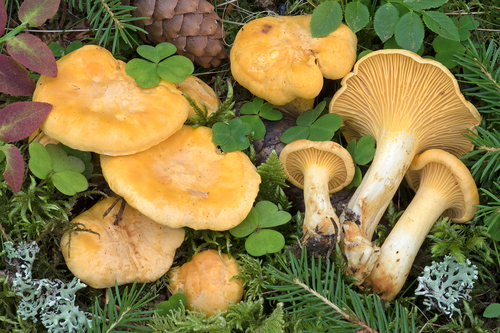
Golden Chanterelle
Cantharellus cibarius
- Yellow-orange coloring
- Apricot aroma
- Grows scattered on dirt
- Underside: false gills (blunt folds forking down the stem)
- Flesh: white internal flesh
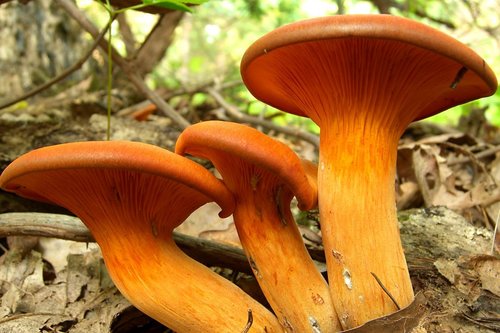
Jack-O'Lantern
Omphalotus illudens
- Dense, fused clusters
- Grows directly on wood logs
- Underside: true gills (sharp, knife-like blades)
- Flesh: orange internal flesh
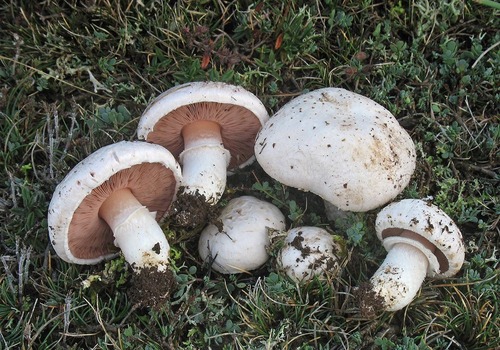
Meadow Mushroom
Agaricus campestris
- White/brown cap
- Open grassy fields only
- Fragile ring on stem
- Underside: gills start bright pink, aging to deep chocolate-brown
- Spore print: chocolate-brown
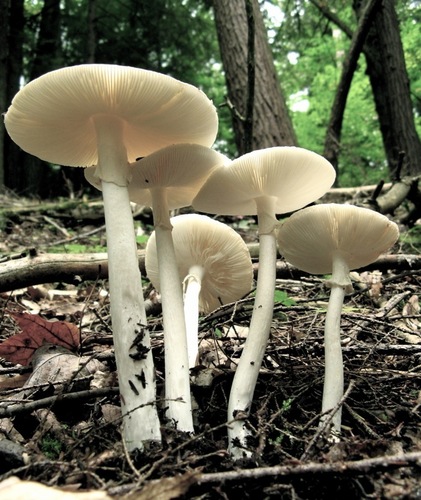
Destroying Angel
Amanita bisporigera
- Deep woods near trees
- Skirt-like ring on stem
- Grows from a buried cup (volva)
- Underside: gills remain stark, pure white for life
- Spore print: pure white
Mid-Atlantic Region (WV, MD, PA, NJ, NY)
Transitional oak forests & rocky river valleys
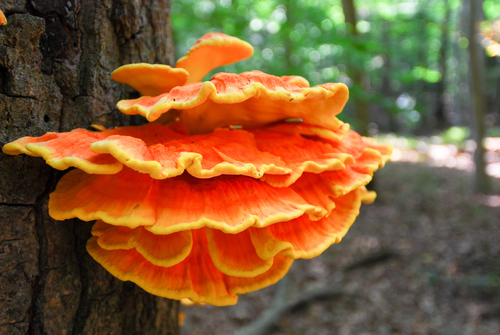
Chicken of the Woods
Laetiporus sulphureus
- Bright orange top, yellow edge
- Overlapping shelves on hardwood logs
- Meaty texture
- Underside: smooth pore surface (microscopic holes, no gills)
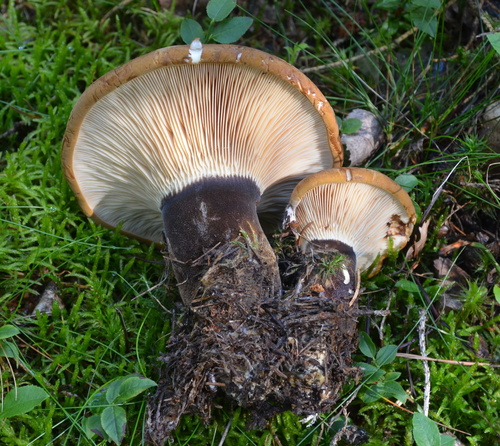
Velvet-Footed Pax
Tapinella atrotomentosa
- Fuzzy dark brown stem base
- Dull, faded color shades
- Underside: true gills underneath
New England Region (CT, MA, VT, NH, ME)
Northern spruce-fir & birch boreal forests
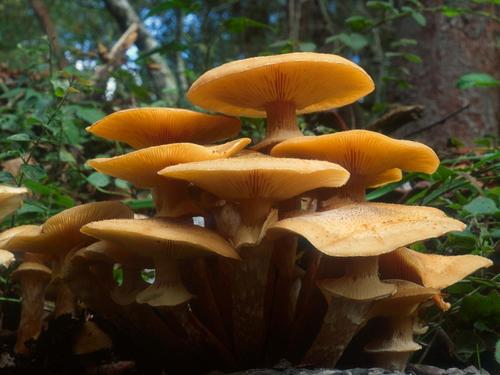
Honey Mushroom
Armillaria mellea
- Massive tight base clusters
- Tiny hair scales on cap center
- Tough, solid stem
- Spore print: white/cream
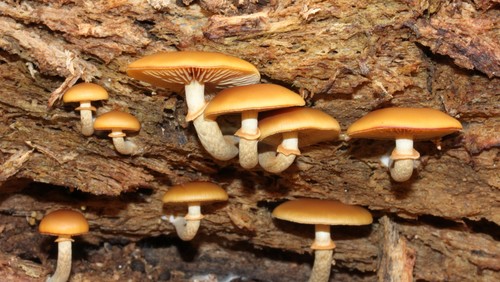
Deadly Galerina
Galerina marginata
- Small loose groups on logs
- Smooth, bald wet cap
- Fragile, hollow stem
- Spore print: rusty-brown
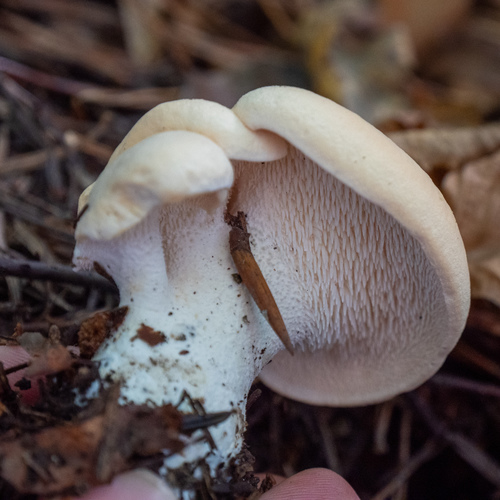
Hedgehog Mushroom
Hydnum repandum
- Creamy orange cap
- Grows on dirt near birch trees
- Snaps like chalk
- Underside: spines/teeth (fragile needles scraped off easily with a fingernail)
No toxic variants carry needles or spines under the cap in this ecosystem.
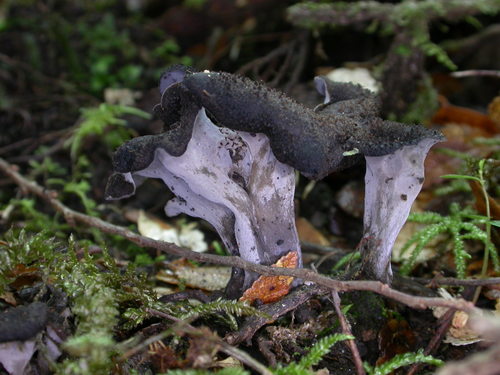
Black Trumpet
Craterellus cornucopioides
- Deep gray to pitch black
- Hollow horn/trumpet shape
- Highly camouflaged in dead leaves
- Underside: smooth to slightly wrinkled skin (completely gill-less)
No poisonous species display a completely hollow, dark funnel frame.
📄 Take This to the Trail
Free one-page printable flyer — disclaimer, emergency protocol, and every regional mushroom pair with photos.
Preview the Free Flyer (PDF) Download PDF