This dataset is provided solely for educational, informational, and entertainment purposes. It does not constitute professional mycological, foraging, medical, or survival advice. Wild mushroom consumption carries inherent, extreme risks, including severe permanent organ damage, neurological injury, or death. Neither the author, data creator, nor software platform assumes any responsibility, liability, or obligation for any injury, illness, loss of life, or adverse reactions resulting from the use, interpretation, misinterpretation, or application of this data. Users forage entirely at their own risk.
By accessing, viewing, or using this guide, the end-user explicitly agrees to hold harmless the developer, publishers, and distributors from any claims, damages, liabilities, costs, or medical expenses arising from foraging decisions.
Universal Safety Protocols
Golden Rule: When in doubt, throw it out. Never consume a wild mushroom based on a single field identification asset.
- 1. Verify Every Marker Verify 100% of the key visual markers listed in the specific regional profile.
- 2. Take a Full Spore Print Take a complete spore print on both white and black paper if a lookalike has a distinct spore color requirement.
- 3. Confirm the Host Ensure the specimen is growing on the documented host wood or soil matrix.
- 4. Inspect for Contamination Check for signs of insect infestation, decay, or chemical spray contamination before harvesting.
- 5. Keep a Voucher Specimen Retain one un-cooked, intact specimen in a paper bag in the refrigerator as a voucher for medical teams in case of accidental poisoning.
Emergency Poison Control Contacts
| Region | Contact | Number | Notes |
|---|---|---|---|
| National / Universal (US) | America's Poison Centers | 1-800-222-1222 | 24/7/365 — routes automatically to the nearest regional poison center based on area code or cellular connection tower. |
| California | California Poison Control System | 1-800-222-1222 | calpoison.org |
| Oregon | Oregon Poison Center | 1-800-222-1222 | ohsu.edu |
| Washington | Washington Poison Center | 1-800-222-1222 | wapc.org |
1. Southern California (Desert & Chaparral) Elevation 3,000-9,000 ft · Laguna Mountains to San Jacinto Mountains
Arid desert and chaparral foraging zones
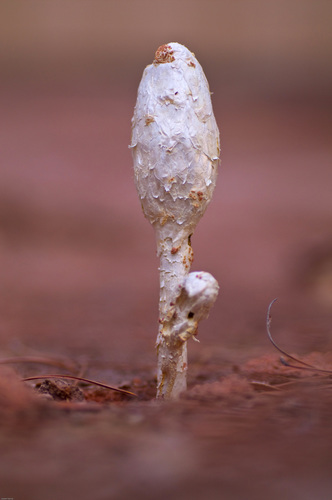
Photo: (c) Jasper Nance, CC BY-NC-ND, via iNaturalist
Desert Shaggy Mane
Podaxis pistillaris
- Cap: elongated, woody, white to tan, scales present, does not deliquesce easily
- Gills: internal spore mass (gleba), turns black and powdery with maturity
- Stem: woody, fibrous, central, extends deep into sandy soil
- Spore print: blackish-brown
- Habitat: arid soils, desert roadsides, chaparral clearings
- Season: late winter to early spring (after rare desert rains)
🍳 Cooking note: Only harvest and eat while young, when the interior flesh is still pure white and firm — like all puffball-type mushrooms, it becomes inedible once the gleba starts turning black and powdery with spores. Slice and sauté thoroughly before eating.
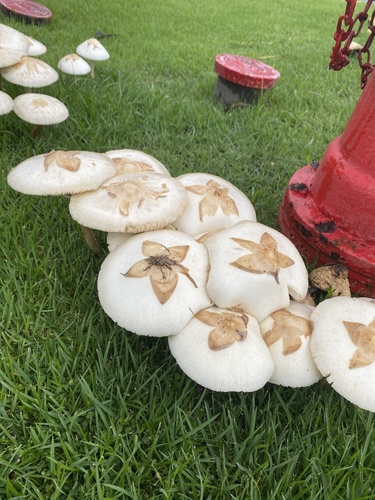
Photo: (c) axelemilio, CC BY-NC, via iNaturalist
False Parasol
Chlorophyllum molybdites
Onset: 1-3 hours
Symptoms: Violent explosive vomiting, severe diarrhea, intense abdominal cramping
- Cap: convex to flat, white with scattered brownish scales
- Gills: free from stem, white aging to distinct grayish-green
- Stem: smooth, white to brown, thick movable ring
- Spore print: green to dull olive-green
- Habitat: grassy lawns, trailsides, disturbed chaparral soils
- Season: summer to early autumn
2. Central California (Sierra Nevada Foothills & High Sierra) Elevation 5,000-10,000 ft · Kennedy Meadows to Sonora Pass
Conifer forests along the high Sierra crest
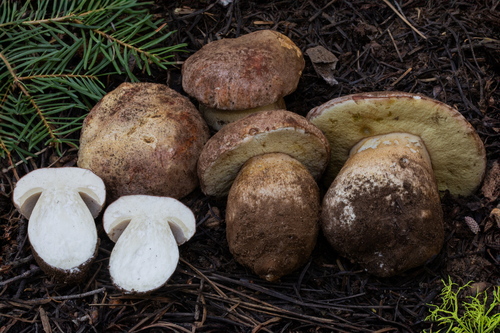
Photo: (c) Dean Lyons, CC BY-NC, via iNaturalist
Sierra Porcini
Boletus rex-veris
- Cap: reddish-brown to pinkish-buff, sticky when wet, thick flesh
- Gills: pores instead of gills, white when young turning yellow-green
- Stem: thick, bulbous, club-shaped, covered in white reticulation (netting)
- Spore print: olive-brown
- Habitat: associated with Red Fir and Lodgepole Pine
- Season: spring to early summer (as snowmelt recedes)
Smith's Bolete
Caloboletus smithii
Onset: 30 min-2 hrs
Symptoms: Nausea, vomiting, diarrhea, severe stomach pain
- Cap: olive-brown to clay-colored, dry, smooth
- Gills: pores instead of gills, yellow, bruising instantly blue when touched
- Stem: yellow at top, pinkish-red toward base, lacks prominent netting
- Spore print: olive-brown
- Habitat: mixed conifer forests, often overlapping with true boletes
- Season: summer
3. Northern California (Cascades & Klamath Mountains) Elevation 3,000-7,000 ft · Castle Crags to Cascade Range
Second-growth Douglas-fir and Western Hemlock forests
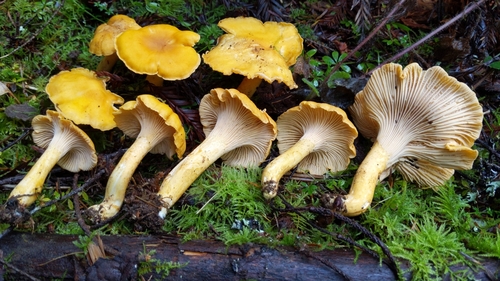
Photo: (c) Alan Rockefeller, CC BY, via iNaturalist
Pacific Golden Chanterelle
Cantharellus formosus
- Cap: orange to dull yellow, wavy margins, trumpet-shaped, smells of apricot
- Gills: false gills, blunt ridge-like forks running down the stem (decurrent)
- Stem: solid, meaty, same color as cap, tapers toward base
- Spore print: pale yellowish-white
- Habitat: deep moss, second-growth Douglas-fir and Western Hemlock forests
- Season: autumn (after first heavy rains)
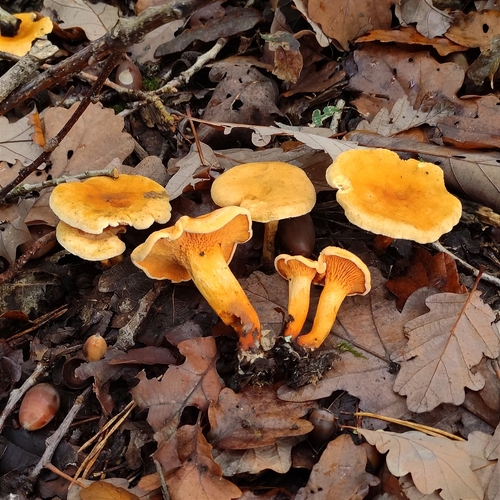
Photo: (c) Matthieu Morin, CC BY-NC, via iNaturalist
False Chanterelle
Hygrophoropsis aurantiaca
Onset: 1-4 hrs
Symptoms: Nausea, mild cramping, gastrointestinal upset, occasionally diarrhea
- Cap: bright orange to brownish-orange, funnel-shaped, velvet texture
- Gills: true gills, thin, crowded, repeatedly forked, brightly colored orange
- Stem: hollow, thin, flexible, often darker orange-brown at base
- Spore print: white
- Habitat: decaying wood, wood chips, conifer forest floors
- Season: autumn to early winter
4. Oregon (Cascade Mountains) Elevation 2,000-6,000 ft · Ashland to Columbia River Gorge
Sandy soils under Lodgepole Pine and Shasta Red Fir
Matsutake
Tricholoma murrillianum
- Cap: white, developing brown scales, spicy cinnamon-red-hot-candy odor
- Gills: white, closely spaced, notched attached to stem
- Stem: solid, tough, white, thick cottony veil present
- Spore print: white
- Habitat: sandy soils under Lodgepole Pine and Shasta Red Fir
- Season: autumn
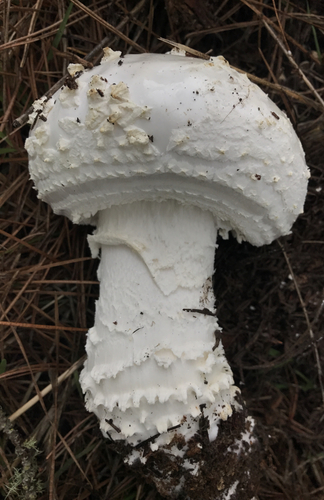
Photo: (c) Christian Schwarz, CC BY-NC, via iNaturalist
Smith's Amanita
Amanita smithiana
Onset: DELAYED 4-12 hours (often mimics standard food poisoning initially before kidneys fail at 2-6 days)
Symptoms: Delayed severe vomiting, diarrhea, acute abdominal pain, followed by decreased urination, extreme thirst, total kidney failure
- Cap: white to cream, rough with easily rubbed-off floccose warts, faint earthy smell
- Gills: white to cream, free or closely attached, crowded
- Stem: white, rooting bulbous base below ground, fragile, sticky veil shreds
- Spore print: white
- Habitat: mixed conifer forests, frequently growing alongside Matsutake
- Season: autumn
5. Washington (Cascades & Olympic Peninsula Boundary) Elevation 2,000-7,500 ft · Columbia River to Pasayten Wilderness
Conifer and hardwood boundary forests
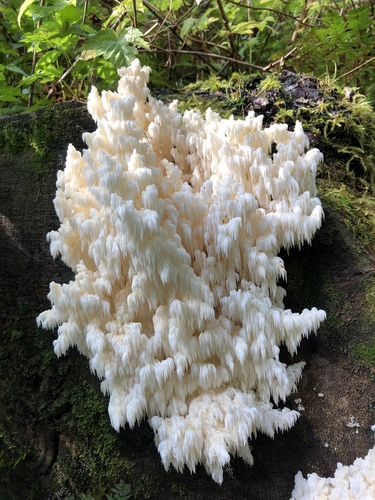
Photo: (c) ntune, via iNaturalist
Bear's Head Tooth
Hericium abietis
- No traditional cap — forms a cascading mass of white icicle-like spines, 1-2 cm long, hanging in clusters
- Short tough central branches from a single base
- Spore print: white
- Habitat: growing directly out of dead or dying conifer logs (especially Fir and Hemlock)
- Season: autumn
🍳 Cooking note: Sauté thoroughly until golden brown to break down its dense, fibrous branching structure before eating.
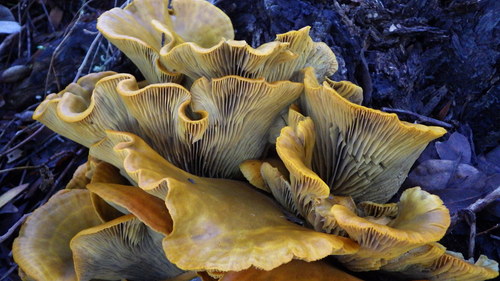
Photo: (c) Lorri G., CC BY-NC-ND, via iNaturalist
Jack-O'Lantern Mushroom
Omphalotus olivascens
Onset: 1-3 hrs
Symptoms: Severe unrelenting vomiting, severe abdominal pain, watery diarrhea, profuse sweating, heavy salivation
- Cap: olive-orange to brown, flat to funnel-shaped, distinctly structured (unlike Hericium)
- Gills: true sharp gills, decurrent, glow faintly bioluminescent in pitch dark
- Stem: solid, central or off-center, fibrous, tapering down
- Spore print: cream to whitish
- Habitat: clusters at base of dead hardwood trees or buried roots (rarely conifers)
- Season: autumn
📄 Take This to the Trail
Free one-page printable flyer — disclaimer, safety protocols, poison control contacts, and every regional mushroom pair with photos.
Preview the Free Flyer (PDF) Download PDF