This guide covers 8 toxic mushroom species clinically relevant to Atlantic Canada (New Brunswick, Nova Scotia, Prince Edward Island, and Newfoundland & Labrador). Four are Tier 1 Critical with potentially fatal outcomes; four are Tier 2 Severe requiring urgent care. Onset ranges from 15 minutes to 3 weeks. The 2–21 day latency of Cortinarius rubellus (orellanine nephrotoxicity) is the most dangerous diagnostic trap — always ask about mushroom consumption in any unexplained acute kidney injury. Paxillus involutus presents a cumulative immune hemolysis hazard with historic significance in Atlantic fishing and rural foraging communities: a patient may eat this mushroom for years before a sudden fatal hemolytic crisis — prior tolerance does NOT rule out poisoning.
For licensed healthcare providers only. This document is a clinical decision-support tool and does not replace poison control consultation, toxicology specialist guidance, or local institutional protocols. Species confirmation is the role of a trained mycologist. When in doubt, contact IWK Poison Centre (NS/NB/PEI): 1-800-565-8161 or Eastern Health (NL): 1-866-354-5551.
Quick Reference — All Species
Species
Toxin
Onset
Key Symptoms
Severity
Destroying Angel Amanita virosa
Amatoxin
Delayed 6–24h
GI → hepatic/renal failure (triphasic)
CRITICAL
Deadly Webcap Cortinarius rubellus
Orellanine
Extreme 2–21 days
Renal failure (delayed), oliguria
CRITICAL
Autumn Skullcap Galerina marginata
Amatoxin
Delayed 6–24h
GI → hepatic/renal failure (triphasic)
CRITICAL
False Morel Gyromitra esculenta
Gyromitrin/MMH
Delayed 6–12h
GI, hemolysis, hepatic necrosis, seizures
CRITICAL
Brown Roll-Rim Paxillus involutus
IgG antigen
Delayed 0.5–3h
Intravascular hemolysis, shock, renal failure
SEVERE
Fly Agaric Amanita muscaria
Ibotenic acid/Muscimol
Rapid 30 min–2h
Delirium, ataxia, sedation (NOT cholinergic)
SEVERE
Ivory Funnel Clitocybe dealbata
Muscarine
Rapid 15–30 min
SLUDGE: salivation, lacrimation, bradycardia
SEVERE
Fibrecap (Inocybe spp.) Inocybe geophylla & related
Muscarine
Rapid 15–30 min
SLUDGE: identical to Clitocybe dealbata
SEVERE
🌎 Atlantic Canada — Regional Foraging Context
Boreal & Acadian Forest Risk Profile
Atlantic Canada's Acadian and boreal forest mosaic creates distinct mushroom poisoning patterns. Spring foraging (May–June) targets morel season and is the primary window for Gyromitra esculenta poisoning — particularly in fishermen and rural communities who know woods seasonally. Coastal lawns and salt marsh grasslands create a unique Clitocybe dealbata exposure risk not seen in inland provinces. Maritime foraging culture in fishing communities (particularly along the Bay of Fundy, Cape Breton, and Newfoundland outport communities) means rural providers should maintain high clinical suspicion for Paxillus involutus hemolysis — this species has historically been consumed in rural Atlantic Canada with apparent safety before sudden crisis.
🔴 Tier 1 — Critical
Potentially Fatal — All require immediate emergency evaluation
Four species with lethal potential: amatoxin hepatorenal failure (Amanita virosa, Galerina marginata), orellanine delayed nephrotoxicity (Cortinarius rubellus), and gyromitrin multi-system poisoning (Gyromitra esculenta). Standard 6-hour ER clearance is inadequate — onset can be delayed 6–21 days.
Destroying Angel (European Destroying Angel)
Amanita virosa
CRITICALTier 1Onset: 6–24h
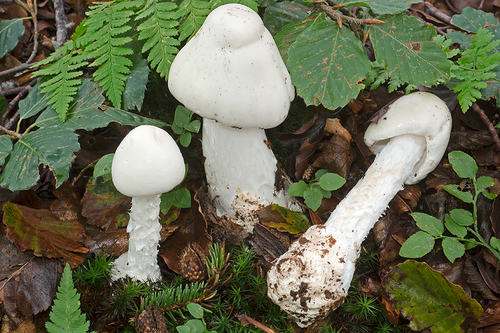
Amanita virosa — European Destroying Angel. Entirely white with ring and sack-like volva at base. Photo: iNaturalist open data (CC-licensed).
Habitat — Atlantic Canada
Dominant white Amanita of Atlantic boreal and Acadian mixed forest. Grows on ground under spruce, fir, birch, and mixed hardwoods. July–October. Nova Scotia highlands, Cape Breton, New Brunswick forests, PEI woodlots, Newfoundland boreal.
Field Marks — Check ALL
Entirely white — cap, gills, stem, flesh
Skirt-like ring (annulus) on upper stem
Sack-like volva at base — MUST dig to expose (often buried in duff)
White spore print
Faint unpleasant odour at maturity
Toxin
Alpha-amanitin (amatoxin). RNA polymerase II inhibitor. No safe threshold. Heat-stable — cooking does NOT destroy toxin. Lethal dose: ~0.1 mg/kg (roughly half a cap).
Treatment: No antidote. Contact poison control immediately. IV fluids and electrolyte correction. N-acetylcysteine (hepatoprotective dosing). Silibinin (silymarin) IV where available — contact regional liver centre. Early liver transplant team notification at INR > 2. Serial LFTs, INR, creatinine q4-6h. Decontamination only if <2h post-ingestion and no vomiting.
INR Monitoring: Monitor INR every 6–8 hours alongside LFTs — INR changes often precede AST/ALT spikes and tracks liver synthesis failure more accurately.
🐾 Veterinary Note (Tier 1): Grave prognosis in dogs. Liver failure can develop within 36 hours. Immediate aggressive decontamination and hepatoprotectants are mandatory. Decontamination window: gastric lavage or activated charcoal must be initiated within 2–4 hours post-ingestion. Standard decontamination is ineffective once the GI phase settles due to rapid canine metabolic rates.
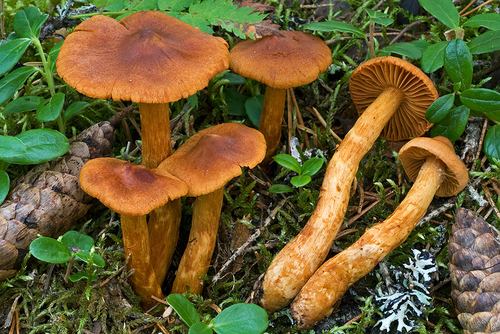
Cortinarius rubellus — Deadly Webcap. Note rust-brown colouring and absence of ring (cobweb cortina collapses). Photo: iNaturalist open data (CC-licensed).
⚠ Critical Diagnostic Warning — Atlantic Canada
Orellanine: 2–21 Day Latency Period
Cortinarius rubellus is the leading cause of delayed nephrotoxic mushroom poisoning in Atlantic Canada. The apparent recovery phase (Days 3–14) means patients present to nephrology or nephrology follow-up — not to emergency — with AKI of unknown origin. Ask about mushroom consumption in the prior 3 WEEKS for any unexplained acute kidney injury.
Rust-brown spore print is the key diagnostic field mark. Cortina (cobweb partial veil) leaves a rust-brown zone on the stem of young specimens.
Habitat — Atlantic Canada
Boreal conifer and mixed forest. Grows with spruce, fir, pine, and birch. NB, NS highlands, Cape Breton, NL boreal. August–October. Frequently found alongside edible chanterelles and boletes — misidentification by experienced foragers.
Field Marks
Reddish-brown to tawny cap (3–8 cm)
Rust-brown spore print — diagnostic
No ring (cortina leaves rust zone on young stems only)
Gills rust-brown at maturity
Earthy odour
Orellanine — 3-Phase Timeline
Phase 1 — Days 1–3: GI
Nausea, vomiting, diarrhoea
Thirst, headache, myalgia
May be mild or absent
Phase 2 — Days 3–14: Apparent Recovery
GI resolves — patient appears well
This is the diagnostic trap
Orellanine disrupting proximal tubular cells
Phase 3 — Weeks 2–3: Renal Failure
Acute tubulointerstitial nephritis
Oliguria, rising creatinine and BUN
Permanent renal damage possible
Dialysis required in severe cases
Treatment: No antidote for orellanine. Supportive renal care. Monitor creatinine, BUN, urinalysis daily once identified. Nephrology consultation. Dialysis for oliguric renal failure. Identify and test ALL persons who ate from the same forage. Long-term renal follow-up for months to years.
🐾 Veterinary Note (Tier 1): Progressive renal failure in companion animals. Diagnosis often delayed due to the same 3–14 day window. Serial BUN/creatinine tracking and early nephrology consultation essential. Decontamination window: gastric lavage or activated charcoal must be initiated within 2–4 hours post-ingestion. Standard decontamination is ineffective once the GI phase settles due to rapid canine metabolic rates.
Autumn Skullcap
Galerina marginata
CRITICALTier 1Onset: 6–24h
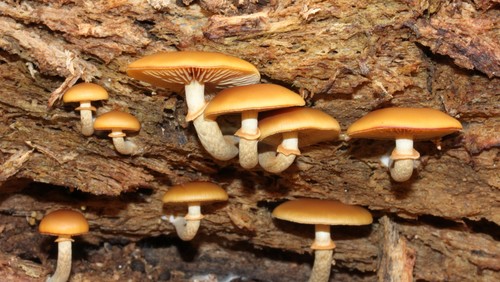
Galerina marginata — Autumn Skullcap. Small tawny cap with brown ring on decaying log. Photo: iNaturalist open data (CC-licensed).
Habitat — Atlantic Canada
Decaying hardwood and conifer logs and stumps throughout Atlantic Canada. Grows in dense clusters. August–November. Common on birch, alder, and spruce logs in damp boreal settings.
Field Marks — Critical ID
Small (2–5 cm) tawny-brown cap
Brown ring on stem — key diagnostic feature
Rust-brown spore print
Brown gills
Grows on decaying wood (not ground)
Toxin — Identical to Death Cap
Alpha-amanitin (amatoxin) — identical toxin profile and dose to Amanita phalloides. A small number of caps contains a lethal dose. Clinical course triphasic — identical to Amanita virosa (above).
Honey Mushroom Confusion
Lookalike Confusion Panel
SAFE
Honey Mushroom (Armillaria spp.)
White to pinkish-buff gills (not brown), white to pinkish-buff spore print (not rust), ring may be present, grows on wood or from buried roots. Popular edible in Atlantic Canada — must confirm white spore print.
TOXIC
Galerina marginata (this species)
Brown gills, rust-brown spore print, brown ring. Mixed clusters with honey mushroom on same logs. A single misidentified cap is potentially fatal.
Treatment: Identical to Amanita virosa (amatoxin protocol). IV fluids, N-acetylcysteine, silibinin where available. Serial LFTs q4-6h. Early liver transplant team notification. Do NOT discharge after GI phase resolves.
INR Monitoring: Monitor INR every 6–8 hours alongside LFTs — INR changes often precede AST/ALT spikes and tracks liver synthesis failure more accurately.
🐾 Veterinary Note (Tier 1): Same amatoxin toxicology as Destroying Angel. Potentially fatal in dogs. Apply identical decontamination and hepatoprotectant protocol. Decontamination window: gastric lavage or activated charcoal must be initiated within 2–4 hours post-ingestion. Standard decontamination is ineffective once the GI phase settles due to rapid canine metabolic rates.
False Morel
Gyromitra esculenta
CRITICALTier 1Onset: 6–12h
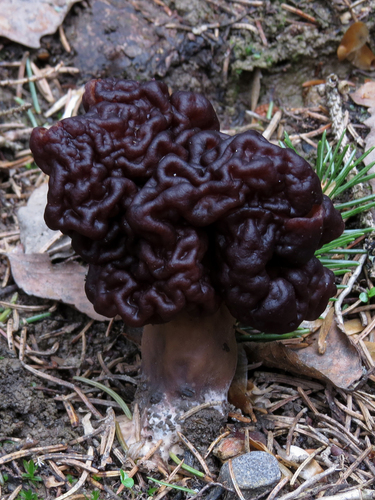
Gyromitra esculenta — False Morel. Brain-like wrinkled cap (compare true morel: honeycomb-pitted, fully hollow). Photo: iNaturalist open data (CC-licensed).
⚠ TRIAGE TEAM — Ask This QuestionAsk whether the patient was COOKING the mushrooms — not just eating them. Steam inhalation during boiling/parboiling releases monomethylhydrazine (MMH) vapour. A patient may present with seizures from vapour inhalation without having consumed any mushroom. This changes your treatment approach: STAT IV Pyridoxine 25 mg/kg for inhalation seizures.
Habitat — Atlantic Canada Spring
Atlantic boreal spring fruiting: May–June window after snowmelt. Grows in sandy soil under conifers, forest edges, disturbed areas. NS, NB, PEI, NL. Primary risk window coincides with morel foraging season — critical confusion risk.
Parboiling Myth
Parboiling does NOT reliably make Gyromitra safe. Some gyromitrin is volatilized during cooking but residual toxin remains. Additionally, parboiling RELEASES MMH vapour causing bystander/cook poisoning. This mushroom has no safe preparation method.
True Morel vs. False Morel
Cap Distinction — Field Marks
SAFE
True Morel (Morchella spp.)
Honeycomb-pitted cap (ridges and pits), cap attached to stem at base, fully hollow when sliced vertically, spring fruiting under hardwoods and disturbed soil.
TOXIC
False Morel (Gyromitra esculenta)
Brain-like wrinkled/lobed cap (NOT honeycomb), cottony interior fibres (NOT fully hollow), reddish-brown to saddle-brown colour. Spring boreal conifer forest.
Toxin
Gyromitrin, hydrolysed to monomethylhydrazine (MMH). Multi-system: GI, methemoglobinemia, haemolysis, hepatic necrosis. MMH is also a volatile vapour — inhalation toxicity.
Treatment:IV Pyridoxine (Vitamin B6) 25 mg/kg (up to 15–20g) for seizures — repeat if needed (total max 15–20g/day). Methylene blue 1–2 mg/kg IV for methemoglobinemia >30%. Supportive: IV fluids, antiemetics. Monitor LFTs, CBC (haemolysis), MetHb levels. Exchange transfusion for severe haemolysis. Liver transplant assessment for hepatic necrosis.
🐾 Veterinary Note (Tier 1): MMH is toxic to dogs — hemolysis and hepatic injury. Decontamination window: gastric lavage or activated charcoal must be initiated within 2–4 hours post-ingestion. Standard decontamination is ineffective once the GI phase settles due to rapid canine metabolic rates.
🟠 Tier 2 — Severe
Severe — Urgent Medical Evaluation Required
Four species with serious and potentially life-threatening presentations: immune hemolysis (Paxillus involutus), neurological toxidrome (Amanita muscaria), and cholinergic toxidrome with muscarine (Clitocybe dealbata, Inocybe spp.). Not typically fatal but require targeted emergency management.
Brown Roll-Rim
Paxillus involutus
SEVERETier 2Onset: 30 min–3h post meal
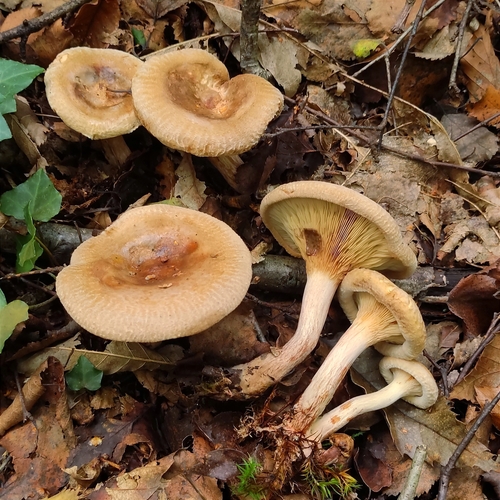
Paxillus involutus — Brown Roll-Rim. Note characteristic inrolled cap margin and gills that bruise dark on handling. Photo: iNaturalist open data (CC-licensed).
Years of Safe Eating Does NOT Rule Out Paxillus Poisoning
This is the most important clinical fact about Paxillus involutus. The mechanism is cumulative IgG-sensitization — each meal builds antibody titre silently. A sudden hemolytic crisis can occur after years or decades of apparently safe consumption. Do not dismiss this diagnosis because "the patient has eaten this mushroom for 20 years without problems." Rural Atlantic communities along the Bay of Fundy, Cape Breton, and Newfoundland outport areas have historic mushroom foraging traditions where this species has been consumed. Prior tolerance is not protective.
Elevated Paxillus Risk in Newfoundland: Ecological and Clinical Factors
Paxillus involutus associates heavily with introduced urban birch and native alder bogs throughout Newfoundland, creating unusually dense exposure corridors in both urban green spaces and remote bog ecosystems. Poisoning density spikes in late summer due to Newfoundland's unique ecological isolation — insular forest ecosystems with limited forager competition and high fruiting density create conditions where this species dominates large foraging patches.
Critical hemolysis timing note: In patients with a history of multiple prior ingestions (sensitization having already occurred), onset of intravascular hemolysis can begin within 1 to 3 hours — significantly faster than the textbook 30-minute–3-hour onset seen in first-sensitization presentations. The cumulative immune priming of isolated rural communities with multi-generational Paxillus exposure histories may compress the hemolytic onset window dramatically.
⚠ EXPLICIT WARNING — Prior Safe Ingestions Are NOT Protective: A Newfoundland patient who reports eating this mushroom safely every autumn for years or decades is NOT at lower risk — they are at higher risk. Each prior meal has silently elevated IgG antibody titre. The absence of prior reaction does NOT rule out — and actively increases the probability of — a sudden acute hemolytic crisis on subsequent exposure. Treat all presentations regardless of foraging history.
Habitat — Atlantic Canada
Damp acidic soils in birch and coniferous forest throughout Atlantic Canada. Very common in NB, NS, and NL mixed boreal forest. August–November. Frequently grows along forest roadsides and in disturbed areas.
Field Marks
Brown cap (5–15 cm) with inrolled margin — even in mature specimens
Decurrent gills that bruise dark brown-black on handling
Brown spore print
Grows on ground (not wood)
Associated with birch and conifers
Mechanism
IgG-mediated immune response against antigens in Paxillus. Cumulative sensitization with each meal. Critical exposure triggers complement-mediated intravascular haemolysis — acute haemolytic crisis.
Treatment: IV resuscitation. Blood transfusion for symptomatic anaemia. Aggressive IV hydration for renal protection (haemoglobin nephropathy prevention). Monitor CBC, LDH, haptoglobin, direct/indirect bilirubin, creatinine q4-6h. Dialysis for oliguric renal failure. No antigen-specific antidote — supportive haemolysis management.
Fly Agaric
Amanita muscaria
SEVERETier 2Rapid: 30 min–2h
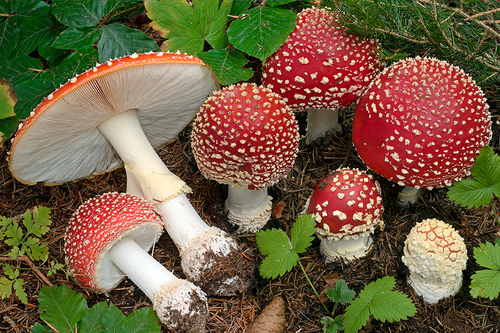
Amanita muscaria — Fly Agaric. Iconic red cap with white wart remnants. Atlantic variety typically red-orange. Photo: iNaturalist open data (CC-licensed).
Habitat — Atlantic Canada
Grows with birch and spruce-fir throughout Atlantic Canada. Very common in NB, NS, and NL boreal forest. August–October. The Atlantic variety is typically red-orange; white wart spots may wash off in rain.
Toxins
Ibotenic acid (NMDA receptor agonist) and muscimol (GABA-A receptor agonist). NOT cholinergic — despite the name "muscaria," muscarine is present only in trace amounts.
Clinical Toxidrome
Isoxazole (ibotenic acid/muscimol) toxidrome — NOT SLUDGE:
• Confusion, disorientation, delirium
• Visual hallucinations, perceptual disturbances
• Ataxia, dysmetria
• Alternating sedation and agitation (cycling every 1–2h)
• Miosis or mydriasis (variable)
• Onset 30 min–2h; duration 6–12h
• Rarely fatal in adults; paediatric risk higher
SLUDGE vs. Atropine
⚠ Do NOT give atropine for Fly Agaric poisoning. SLUDGE symptoms (salivation, lacrimation, urination, defecation, GI distress, emesis) are absent. This is an ibotenic acid/muscimol toxidrome — atropine is not indicated and may worsen delirium.
Treatment: Supportive care in calm, quiet environment. Benzodiazepines for severe agitation. Airway monitoring in deeply sedated patients. Physical restraint only if required for safety. Most cases resolve within 12–24h. Contact poison control for guidance on physostigmine (rarely needed but available for severe cases).
🐾 Veterinary Note: Structural amino acids in these species smell and taste sweet to canines, explaining why dogs specifically target them over other wild fungi. Dogs frequently present comatose or seizing. Provide sensory-deprived veterinary monitoring and respiratory support. Prognosis excellent after 24–48 hour recovery window.
Ivory Funnel
Clitocybe dealbata
SEVERETier 2Rapid: 15–30 min
Photo not yet verified
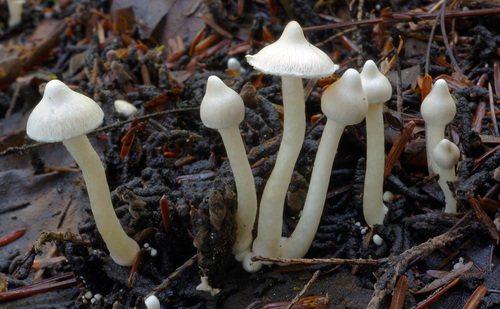
Clitocybe dealbata — small white funnel cap, coastal grassland habitat. Atlantic populations grow in fairy rings in coastal grass near salt marshes.
🌎 Atlantic Coastal Risk Profile
Coastal Lawns & Salt Marsh Grasslands
Clitocybe dealbata has a distinct Atlantic coastal risk profile. It grows in fairy rings in coastal grasslands, lawns bordering salt marshes, and seaside community parks — common in communities throughout the Atlantic provinces. This is NOT a deep forest species. Children in coastal communities playing on lawns, and adults mistaking it for edible fairy ring mushrooms (Marasmius oreades), are the primary exposure pathways.
Treatment:Atropine IV 0.02 mg/kg — titrate to drying of secretions and restoration of heart rate (NOT to full atropinization/pupil dilation). Repeat dosing every 5–15 minutes as needed. Pralidoxime is NOT indicated (muscarine does not phosphorylate AChE). Airway suction for secretions. Supplemental O₂. Monitor for bronchospasm.
Atropine Ceiling: Titrate Atropine to drying of bronchial secretions — not to heart rate or pupil size. Over-titrating based on tachycardia causes independent harm.
Fibrecap (Inocybe species)
Inocybe geophylla and related Atlantic species
SEVERETier 2Rapid: 15–30 min
Inocybe geophylla — White Fibrecap. Small silky-fibrous cap with conical umbo and earthy odour. Representative of Atlantic Inocybe complex. Photo: iNaturalist open data (CC-licensed).
Atlantic Species Panel
Key Atlantic Inocybe Species — All Toxic
TOXIC
I. geophylla (White Fibrecap)
White silky cap, distinctive earthy-musty odour, grows in mixed forest.
TOXIC
I. rimosa / Pseudosperma rimosum (Split Fibrecap)
Tan-brown cap radially split, conical to campanulate, fibrous texture.
Mixed forest under conifers and hardwoods, roadsides, disturbed sandy soil. Throughout NB, NS, PEI, NL. July–October. Multiple species present in Atlantic Canada — treat all Inocybe as toxic.
Toxidrome
Muscarine toxidrome identical to Clitocybe dealbata (SLUDGE): salivation, lacrimation, urination, defecation, GI distress, emesis, plus miosis, bradycardia, bronchospasm. Onset 15–30 min. Treatment is the same.
Clinical Note
Do not wait for species confirmation. Treat the clinical muscarine toxidrome immediately with atropine. Species-level identification is for epidemiology, not for ED management decisions. All Inocybe species should be treated as muscarine sources.
Treatment: Same as Clitocybe dealbata — Atropine IV 0.02 mg/kg titrated to secretion drying and heart rate. Repeat dosing as needed. Airway management for bronchospasm and bronchorrhoea. Monitor and support.
Atropine Ceiling: Titrate Atropine to drying of bronchial secretions — not to heart rate or pupil size. Over-titrating based on tachycardia causes independent harm.
🍁 Atlantic Hardwood Chanterelle Confusion Panel
Cantharellus cibarius — Safe vs. Dangerous Lookalikes in Atlantic Hardwood Areas
Chanterelles are among the most popular foraging targets in Atlantic Canada. Correct identification is essential.
Atlantic Chanterelle Identification
SAFE
Golden Chanterelle (Cantharellus cibarius)
Egg-yolk yellow, forked ridges (not true gills — ridges run partway down stem, fork repeatedly), firm white flesh, fruity apricot aroma, false gills cannot be separated cleanly from cap flesh. Common in Atlantic hardwood-conifer mix.
TOXIC
Jack-o'-Lantern (Omphalotus olearius)
True gills (knife-separable, sharp edges), orange-yellow, grows in clusters at base of hardwood stumps/roots, may glow faintly in dark. GI toxin — severe emesis and diarrhoea. Less common in Atlantic Canada but present in southern NS and NB.
CAUTION
False Chanterelle (Hygrophoropsis aurantiaca)
Orange, thin true gills (densely crowded, separable), funnel-shaped, hollow stem, no fruity aroma. Grows in conifer forest litter. GI irritant in most cases; some neurological symptoms reported. Abundant in Atlantic boreal forest — a common confusion species.
Entry: Patient presents after consuming wild mushrooms or suspected mushroom exposure (including cooking vapour inhalation).
Step 1 — First Question: When did symptoms begin relative to ingestion (or vapour exposure)?
▲ Rapid Onset — Symptoms within 30 min–2h of ingestion
SLUDGE present?→
Muscarine Toxidrome — Likely: Clitocybe dealbata or Inocybe spp. Treat: Atropine IV 0.02 mg/kg titrated. Do NOT give pralidoxime.
Delirium + ataxia, no SLUDGE?→
Ibotenic Acid/Muscimol Toxidrome — Likely: Amanita muscaria. Treat: Supportive, benzodiazepines for agitation. Do NOT give atropine.
GI only, rapid onset?→
GI Irritant or early amatoxin — Draw baseline LFTs, INR, creatinine NOW. Do not discharge. Recheck at 24h and 48h.
▼ Delayed Onset — Symptoms begin 6h or more after ingestion
GI 6–24h, forager?→
Amatoxin suspected — White Amanita (A. virosa) or wood-rotting small brown cap (G. marginata). Serial LFTs q4-6h. Admit. Liver team early alert.
GI 6–12h, spring, cooked?→
Gyromitrin suspected — Gyromitra esculenta. Ask: were mushrooms COOKED? IV Pyridoxine 25 mg/kg for seizures. MetHb level.
Dark urine, haemolysis, history of prior safe eating?→
Paxillus immune haemolysis — Paxillus involutus. CBC, LDH, bilirubin, haptoglobin. IV fluids, transfusion if needed. Prior tolerance is NOT protective.
AKI, no other explanation, history in prior 3 weeks?→
Orellanine nephrotoxicity — Cortinarius rubellus. Ask about mushroom consumption in past 21 days. Nephrology consult. Dialysis for oliguria.
Critical Diagnostic Traps — Atlantic Canada
Trap 1 — The Phase 2 TrapGI resolves after 24h — patient appears well. In amatoxin poisoning this is Phase 2 (false recovery). Transaminases are rising. Do NOT discharge. Admit and monitor LFTs, INR, creatinine at 24h, 48h, 72h.
Trap 2 — The Cortinarius Latency TrapPatient presents to nephrology with AKI — no mushroom history volunteered. Orellanine poisoning can present up to 21 days post-ingestion as apparent idiopathic AKI. Always ask: "Have you eaten any wild mushrooms in the past 3 weeks?"
Trap 3 — The Gyromitra Cooking TrapFamily member didn't eat the mushrooms — they only cooked them. Steam inhalation of MMH from boiling Gyromitra causes seizures in the cook. Ask the patient and all bystanders who was present during cooking.
Trap 4 — The Paxillus Prior Tolerance TrapPatient reports eating this mushroom safely for years. Paxillus involutus causes cumulative IgG sensitization. Prior tolerance is NOT protective. Treat as Paxillus haemolysis even with long history of safe consumption.
Sample Preservation: Wrap physical mushroom samples in paper or foil — never plastic. Refrigerate immediately to preserve microscopic structural features for poison control mycologists.
⚠ Maritime Poison Control Emergency Contacts — Tap to Call