Clinical Use Only. This reference is intended for healthcare providers, poison control specialists, and trained foragers. It is not a foraging identification guide. Always contact the relevant regional Poison Control Centre for real-time case management guidance. Treatment recommendations should be confirmed against current clinical guidelines.
Quick Reference — Key Continental Europe Species
| Common Name | Scientific Name | Tier | Toxin | Onset | Primary Risk |
|---|---|---|---|---|---|
| Death Cap | Amanita phalloides | Tier 1 | Alpha-amanitin | 6–24 hours | Acute hepatic failure, coagulopathy, renal failure |
| Destroying Angel | Amanita virosa | Tier 1 | Alpha-amanitin | 6–24 hours | Acute hepatic failure, coagulopathy, encephalopathy |
| False Morel | Gyromitra esculenta | Tier 2 | Gyromitrin / MMH | 2–12 hours | Seizures, methemoglobinemia, hepatic injury |
| Cloudy Funnel / Brick Red Inocybe | Clitocybe nebularis / Inocybe erubescens | Tier 3 | Muscarine | 15 min–2 hours | SLUDGE syndrome, severe bradycardia, bronchorrhea |
🔴 Tier 1 — Critical Lethal Systemic Toxin
Amatoxin-Bearing Species
Delayed onset (6–24 hours). Biphasic presentation. Acute hepatic failure with coagulopathy. Liver transplant threshold monitoring required. Amanita phalloides is the leading cause of fatal mushroom poisoning worldwide.
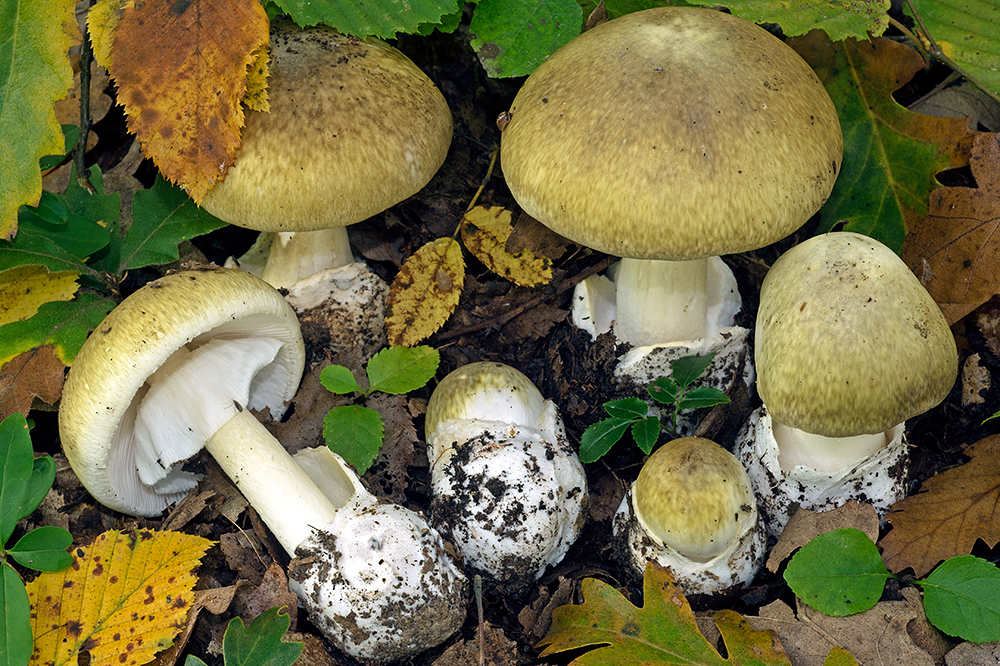
Death Cap
Amanita phalloides
🔴 CRITICAL / LETHAL
Onset 6–24 hours
 iNaturalist
Local Names
Grüner Knollenblätterpilz (German) · Amanite phalloïde (French) · Amanita falloide (Italian)
Season
July–November
Elevation
0–1200m
Habitat
Deciduous and mixed forest edges, oak, beech, chestnut woodland. Often near forest margins and parks.
Distribution
Widespread across all Continental Europe countries
ID Features
Pale greenish-yellow to olive cap 5–15cm. White gills, white stem with skirt ring, white cup-like volva at base. Distinctive sweet honey odor when fresh.
Spore Print
White spores
Toxin
Alpha-amanitin (Amatoxins)
Onset
6–24 hours (average 8–12 hours)
Symptoms
Biphasic — severe GI distress (nausea, vomiting, profuse watery diarrhea), apparent recovery phase 24–72h, then acute hepatic failure, jaundice, coagulopathy, encephalopathy, secondary renal failure
⚠ Lookalike Risk: Paddy straw mushroom (Volvariella volvacea), edible Amanita species, young puffballs. The volva at the base is the key distinguishing feature — always dig to expose the base.
Human Treatment Protocol:
- Aggressive IV fluids to clear toxins and maintain renal perfusion
- Activated charcoal 1 g/kg every 4 hours for 24–48 hours
- IV Silibinin 5 mg/kg loading dose, then 20 mg/kg/day continuous infusion
- IV NAC (N-acetylcysteine) 150 mg/kg loading dose
- Monitor PT/INR, ALT/AST, bilirubin, creatinine every 6 hours
- Evaluate for liver transplant using King’s College Criteria if INR >6.0 or encephalopathy develops
☎ Immediate Poison Control Consultation Required —
France: +33 800 59 59 59 ·
Germany: +49 30 19240 ·
EU: 112
Destroying Angel
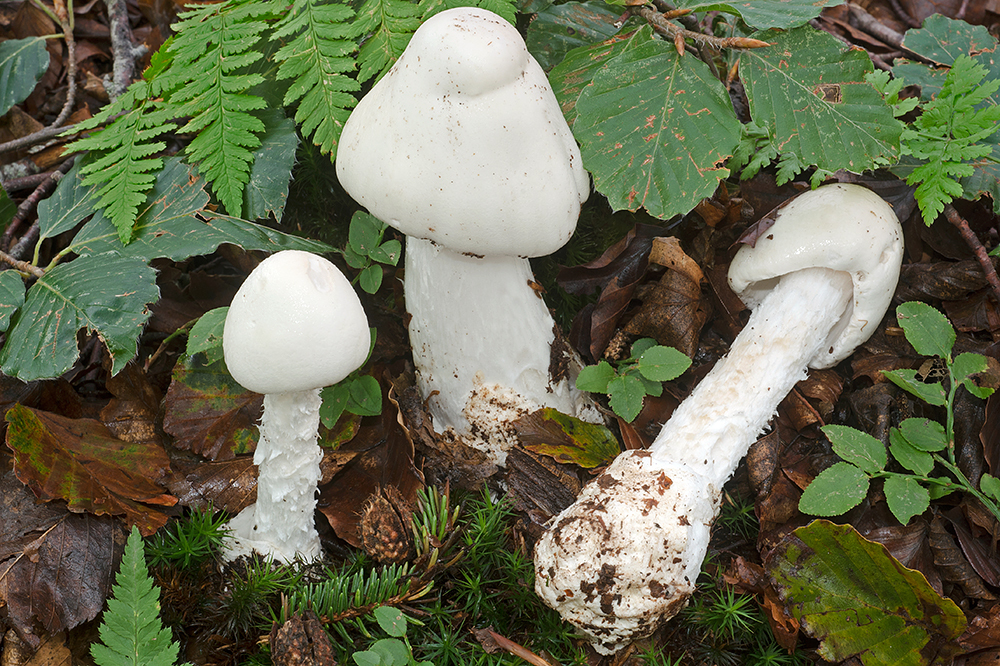
Amanita virosa
🔴 CRITICAL / LETHAL
Onset 6–24 hours
 iNaturalist
Local Names
Weißer Knollenblätterpilz (German) · Amanite vireuse (French)
Season
July–October
Elevation
200–1500m
Habitat
Coniferous and mixed forest, spruce, fir, and pine woodland. Prefers cooler northern and mountainous regions.
Distribution
Northern and central Continental Europe — Poland, Germany, Czechia, Slovakia, Ukraine
ID Features
Pure white cap 5–12cm, white gills, white stem, prominent white skirt ring, white volva at base. No color variation — entirely pure white.
Spore Print
White spores
Toxin
Alpha-amanitin (Amatoxins) — equal potency to Amanita phalloides
Onset
6–24 hours
Symptoms
Identical to Amanita phalloides — biphasic GI then acute hepatic failure, coagulopathy, encephalopathy
⚠ Lookalike Risk: Button mushrooms (Agaricus bisporus), edible field mushrooms, young puffballs. All-white coloration makes this especially dangerous — always check for volva at the base.
Human Treatment Protocol (identical to A. phalloides):
- Aggressive IV fluids
- Activated charcoal 1 g/kg every 4 hours
- IV Silibinin 5 mg/kg loading dose, then 20 mg/kg/day
- IV NAC 150 mg/kg loading dose
- Monitor PT/INR, ALT/AST, bilirubin, creatinine every 6 hours
- King’s College Criteria liver transplant evaluation if INR >6.0 or encephalopathy
☎ Immediate Poison Control Consultation Required —
France: +33 800 59 59 59 ·
Germany: +49 30 19240 ·
EU: 112
🟠 Tier 2 — Severe Neurological / Systemic Toxin
Gyromitrin-Bearing Species
Onset 2–12 hours. GI phase followed by neurological phase from GABA depletion. Methemoglobinemia possible. IV Pyridoxine (Vitamin B6) is the definitive treatment for seizures.
False Morel
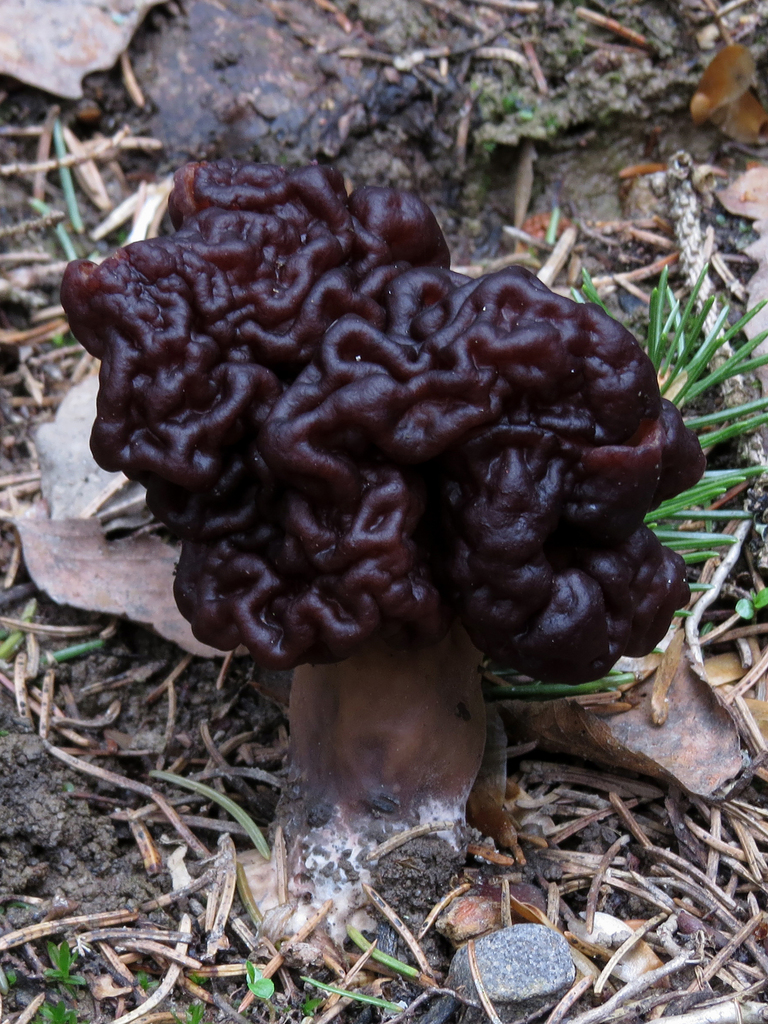
Gyromitra esculenta
🟠 SEVERE / POTENTIALLY FATAL
Onset 2–12 hours
 iNaturalist
Local Names
Frühjahrslorchel (German) · Gyromitre comestible (French) · Falsa morchella (Italian)
Season
March–May (spring only)
Elevation
200–2000m
Habitat
Sandy coniferous forest, pine and spruce edges, recently cleared or burned forest areas
Distribution
Germany, Poland, Czechia, Slovakia, Hungary, Ukraine — widespread across northern Continental Europe
ID Features
Brain-like wrinkled reddish-brown to dark brown saddle-shaped cap 5–15cm. Hollow when sliced. White irregular stem. Does NOT have honeycomb pitting of true morels.
Spore Print
White to pale yellowish spores
Toxin
Gyromitrin (converts to monomethylhydrazine — MMH)
Onset
2–12 hours
Symptoms
GI phase — nausea, vomiting, abdominal cramping, watery diarrhea. Neurological phase — severe headache, dizziness, seizures from GABA depletion, methemoglobinemia, hemolysis, hepatic injury in severe cases.
⚠ Lookalike Risk: True Morel (Morchella esculenta) — TRUE morel has honeycomb pitting, hollow cap and stem continuous. False morel has brain-like wrinkled cap and is NOT continuous with the stem.
Human Treatment Protocol:
- IV Pyridoxine (Vitamin B6) 25 mg/kg IV — definitive treatment for seizures, reverses GABA depletion caused by MMH
- IV Methylene blue 1–2 mg/kg for methemoglobinemia if present
- Activated charcoal 1 g/kg if within 1–2 hours of ingestion
- Aggressive IV fluid resuscitation
- Benzodiazepines for seizure control
- Monitor methemoglobin levels, LFTs, CBC
- Supportive care for hemolysis
☎ Immediate Poison Control Consultation Required —
France: +33 800 59 59 59 ·
Germany: +49 30 19240 ·
EU: 112
🟡 Tier 3 — Acute Autonomic Toxin
Muscarine-Bearing Species
Rapid onset 15 minutes to 2 hours. Direct parasympathetic overstimulation (SLUDGE syndrome). Does not cross the blood-brain barrier. Atropine Sulfate is the definitive physiological antidote.
Cloudy Funnel / Brick Red Inocybe
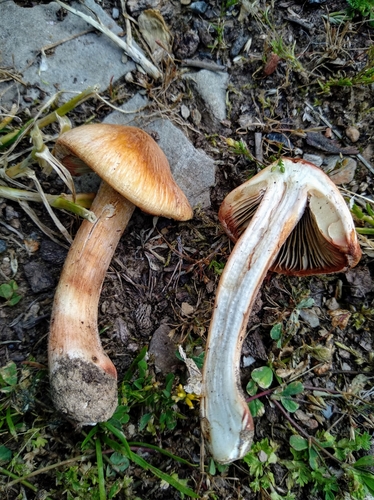
Clitocybe nebularis / Inocybe erubescens
🟡 HIGH PERIPHERAL TOXICITY
Onset 15 min–2 hours
 iNaturalist
Local Names
France: Clitocybe nébuleux, Inocybe de Patouillard
Germany: Nebeltrichterling, Ziegelroter Risspilz
Belgium: Clitocybe nébuleux / Nevelzwam
Netherlands: Nevelzwam, Vezelkop
Poland: Lejkówka szarawa, Strzępiak ceglasty
Czechia: Strmělka mlženka, Vláknice začervenalá
Germany: Nebeltrichterling, Ziegelroter Risspilz
Belgium: Clitocybe nébuleux / Nevelzwam
Netherlands: Nevelzwam, Vezelkop
Poland: Lejkówka szarawa, Strzępiak ceglasty
Czechia: Strmělka mlženka, Vláknice začervenalá
Season
September–November (extended to December in mild conditions)
Elevation
Sea level to ~1,800m
Habitat
Saprotrophic on thick forest floor leaf litter. Mixed broadleaf woodland (beech, oak) and conifer plantations (spruce, pine). Often forms large arcs or fairy rings.
Distribution
Widespread across France, Germany, Belgium, Netherlands, Poland, Czechia
ID Features
Cap 5–15cm, convex with inrolled margin when young, expanding to flat or funnel-shaped. Cloudy-grey to ash-grey or pale brownish-grey, fine white frosting when young. Creamy white to pale buff gills, closely spaced, slightly decurrent. Intensely strong, cloying, sweetish-foul or turnip-like odor.
Lookalikes
Entoloma sinuatum (Livid Pinkgill) — distinguished by pink spore print and sinuate gill attachment. Clitocybe dealbata/rivulosa — lethal muscarine producers, smaller, chalky-white, grassland habitat.
Field Diagnostic
Spore print pale cream to white for C. nebularis; brown to tobacco-brown for Inocybe species.
Toxin
Muscarine — thermostable alkaloid, direct agonist at postganglionic parasympathetic muscarinic acetylcholine receptors. Does not cross the blood-brain barrier.
Onset
15 minutes to 2 hours (extremely rapid — differentiates from lethal amatoxin mushrooms which present 6–24 hours)
Symptoms
SLUDGE Syndrome — Salivation, Lacrimation, Urination, Defecation/Diarrhea, Gastrointestinal distress, Emesis. Critical autonomic signs: severe miosis (pinpoint pupils), diaphoresis, sinus bradycardia, hypotension, bronchorrhea, bronchospasm.
Human Treatment Protocol:
- Decontamination: Avoid emetics due to spontaneous vomiting. Activated charcoal 1g/kg PO only if airway is protected and presentation within 1 hour.
- Aggressive IV crystalloid fluids (Normal Saline or Balanced Salt Solution) to counter fluid loss.
- Atropine Sulfate — definitive physiological antidote. Indication: bradycardia <50bpm, severe bronchorrhea, bronchospasm, or hemodynamically unstable hypotension.
- Adult Dosing: Initial 1–2mg IV push. Repeat every 5–10 minutes until respiratory secretions clear and bradycardia resolves.
- Pediatric Dosing: Initial 0.02mg/kg IV (minimum 0.1mg). Repeat every 5–10 minutes to clinical endpoint (clear lungs).
- DO NOT titrate to pupil dilation — titrate solely to drying of bronchial secretions and normalization of heart rate.
☎ Immediate Poison Control Consultation Required —
France: +33 800 59 59 59 ·
Germany: +49 30 19240 ·
EU: 112
🗺️ Regional Admissions & Dispatch Reference
Poison Control Centers (Human):
- France: +33 800 59 59 59 (Centre Antipoison national — toll free)
- Germany: +49 30 19240 (Giftnotruf Berlin) / +49 89 19240 (Munich)
- Belgium: +32 70 245 245 (Centre Antipoisons)
- Netherlands: +31 30 274 8888 (NVIC — Nationaal Vergiftigingen Informatie Centrum)
- Poland: +48 42 657 99 00 (Łódź Poison Center)
- Czechia: +420 224 919 293 (Prague Poison Center)
- Pan-European Emergency Default: 112
Veterinary Emergency Networks:
- Germany: Tierklinik Hofheim: +49 6192 9099 0 / Kleintierklinik Hannover: +49 511 856 7579
- France: CNITV: +33 4 78 87 10 40
- International/Europe Phone Consult: VPIS: +44 (0) 207 305 5055
🌲 Field Survival & Decontamination Protocols
The Spore Print Protocol:
- Sever the mushroom stem cleanly at the very top, flush with the gills
- Place the cap gills-down on a sheet of paper — half white, half black to capture both light and dark spore drops
- Cover with a small cup or bowl to prevent air currents
- Wait 2–6 hours. Both Amanita species drop white spores. Gyromitra drops white to pale yellowish spores.
Cross-Contamination & Handling Rules:
- Skin Touch is Safe: No known mushroom can poison through intact skin. Wash hands before eating.
- Basket Contamination: If a toxic Amanita is placed in a harvesting basket, discard the entire basket. Fragments break off and adhere to edible flesh.
- Cooking Does NOT Neutralize: Amatoxins are heat stable — cooking, boiling, drying, or freezing does NOT destroy them. Gyromitrin volatilizes partially with prolonged boiling and ventilation but is NOT safe to eat.
- Spore Inhalation: Do not transport mature toxic specimens in tightly sealed unventilated spaces.
🐾 VETERINARY REFERENCE — Dogs & Cats Only
This section is for veterinary use only. All dosing below is for animals. Do not apply to human patients.
Death Cap / Destroying Angel (Amanita phalloides / virosa)
Susceptibility & Onset
Highly lethal. Just 1–2g can kill a 10kg dog. GI signs delay 6–24 hours. Do not wait for symptoms — clinical liver destruction occurs silently during this window.
Clinical Signs
Bloody vomiting/diarrhea, yellow gums (icterus), hypothermia, bleeding, seizures/coma.
Protocol
- Induce emesis only if asymptomatic and within 2 hours of ingestion
- Activated Charcoal 1–2 g/kg PO. Repeat half-doses every 4–6 hours for 24 hours to halt enterohepatic recirculation
- Silibinin (IV): 50 mg/kg IV at 5 hours and 24 hours post-exposure
- N-Acetylcysteine (NAC): Loading dose 140 mg/kg IV slowly over 15–20 minutes, then 70 mg/kg IV every 4 hours for up to 17 doses
- Aggressive IV fluid diuresis. Vitamin K1 (2.5–5.0 mg/kg/day) if coagulopathy develops
False Morel (Gyromitra esculenta)
Susceptibility & Onset
Toxic to dogs and cats. GI signs onset 2–6 hours. Neurological signs may follow.
Clinical Signs
Vomiting, diarrhea, weakness, tremors, seizures, hemolysis (pale gums, weakness).
Protocol
- IV Pyridoxine (Vitamin B6): 25 mg/kg IV — reverses MMH-induced GABA depletion and seizures
- Activated Charcoal 1–2 g/kg PO if within 2 hours
- IV fluid support for hemolysis and hepatic injury
- Benzodiazepines for seizure control
- Monitor CBC, LFTs, methemoglobin
Cloudy Funnel / Inocybe erubescens (Clitocybe nebularis / Inocybe erubescens)
Susceptibility & Onset
High susceptibility in dogs. Hyper-acute onset within 15–30 minutes. Life-threatening parasympathetic overstimulation.
Clinical Signs
Intense drooling (hypersalivation), tearing, bradycardia, miosis, breathing difficulty, explosive diarrhea.
Protocol
- Emesis contraindicated if animal is already vomiting or showing respiratory distress.
- Activated Charcoal: 1–2g/kg PO with aqueous cathartic only if neurologically intact with clear airways.
- Definitive Antidote: Atropine Sulfate. Dose: 0.02–0.04mg/kg. Give 1/4 of dose IV slowly, remaining 3/4 IM or SC. Repeat every 2–4 hours if cholinergic signs or bronchorrhea recur.
- Target endpoint: Resolution of dyspnea, dry mucous membranes, normalized heart rate.
- WARNING: Do not administer atropine if co-ingestion of Amanita muscaria is suspected — severely exacerbates CNS delirium.
- Fluid Therapy: Continuous IV crystalloids at 4–6mL/kg/hour adjusted for dehydration and ongoing losses.
- Antiemetics: Maropitant 1mg/kg SC q24h after muscarinic respiratory symptoms are fully controlled.
Baseline Veterinary Blood Work Panels:
- Complete Blood Count (CBC)
- Liver Function Tests (ALT/AST, Bilirubin)
- Kidney Panels (Creatinine, BUN)
- Coagulation Panels (PT/APTT)
- Methemoglobin level (Gyromitra cases)
🌿 UNIVERSAL FORAGING RULE ZERO: When in doubt, throw it out. Never ingest a wild mushroom based on a single matching characteristic or unverified field app.