About This Guide
This guide covers the 3 most clinically significant toxic mushroom species in Russia's Far Eastern, Kaliningrad, and Arctic regions. The guide is organized around two completely distinct toxidromes — Section A covers the Isoxazole (CNS-altering) toxidrome caused by ibotenic acid and muscimol in Amanita species, and Section B covers the Muscarine (cholinergic crisis) toxidrome caused by muscarine in Clitocybe and related species. These are separate poisoning syndromes with critically different treatment protocols — they must never be mixed.
Antidote note for this guide: IV Silibinin, N-acetylcysteine (NAC), and benzylpenicillin are NOT indicated for any species covered here — none of these species contain amatoxins.
Emergency contacts (tap to call): Emergency 112 • Ambulance 103 • Vladivostok Clinical Hospital No. 2 +7 (423) 232-63-46 • Kaliningrad Regional Clinical Hospital +7 (4012) 578-518 • Moscow Poison Control +7 (495) 628-16-87
Quick Reference — All Three Species
| Species | Common Name | Tier | Toxin | Onset | Toxidrome |
|---|---|---|---|---|---|
| Amanita pantherina | Panther Cap / Мухомор пантерный | Tier 1 | Ibotenic Acid, Muscimol | 30 min – 2 hrs | Section A — Isoxazole (CNS) |
| Amanita muscaria | Fly Agaric / Мухомор красный | Tier 2 | Ibotenic Acid, Muscimol | 30 min – 2 hrs | Section A — Isoxazole (CNS) |
| Clitocybe dealbata | Ivory Funnel / Говорушка беловатая | Tier 2 | Muscarine | 15 – 30 min | Section B — Muscarine (Cholinergic) |
Onset: Rapid — typically 30 minutes to 2 hours post-ingestion
Pantherina Syndrome — two alternating phases:
- Excitation Phase: Confusion, visual and auditory hallucinations, delirium, muscle twitching, spasms, hyper-reactivity
- Depression Phase: Somnolence, dizziness, deep unresponsive coma-like sleep
While the name "muscimol" sounds like "muscarine," Amanita pantherina and Amanita muscaria contain negligible muscarine. Administering atropine to these patients will severely exacerbate the anticholinergic-like CNS excitation, causing profound delirium, dangerous tachycardia, and potentially fatal cardiac arrhythmias. Atropine is absolutely contraindicated in Isoxazole (Section A) poisoning.
Section A — Management Principles
- Aggressive supportive care — secure airway immediately, especially during deep somnolence/coma-like phases
- Cautious benzodiazepine sedation (e.g. Diazepam) only if severe hazardous seizures or extreme uncontrollable agitation during excitation phase
- Keep patient in quiet, dark environment to minimise external stimuli
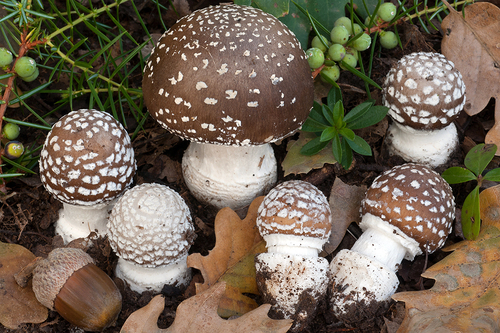
Identification: Cap brown to dark brown with white warts (veil remnants), smooth between warts. Gills white, free. Ring fragile, often disappears. Stem white, slender with a distinct volva-like bulb at base. Spore print white.
Look-alike Risks:
- Mainstream Risk: Misidentified as edible Amanita rubescens (Blusher). Key difference: A. rubescens flesh turns pink/reddish when cut or bruised; A. pantherina flesh remains white. A. rubescens warts are grayish-brown and smear away; A. pantherina warts are pure white.
- Arctic Dwarfism Risk: In permafrost conditions, A. pantherina can grow in a highly stunted compact form where the stem is hidden and the brown warted cap rests flat against reindeer moss. Foragers mistake these for edible Puffballs (Bovista or Lycoperdon species). Diagnostic difference: slicing the specimen vertically reveals a hidden cap, gill structure, and compressed stem base. True puffballs are completely solid and uniform inside.
Symptoms: Rapid onset 30 min–2 hrs. Excitation phase: confusion, visual/auditory hallucinations, delirium, muscle twitching, spasms, hyper-reactivity. Depression phase: somnolence, dizziness, deep unresponsive coma-like sleep. Phases may alternate.
Atropine is absolutely contraindicated. These species contain negligible muscarine. Atropine will severely worsen CNS excitation, causing profound delirium, tachycardia, and potentially fatal arrhythmias.
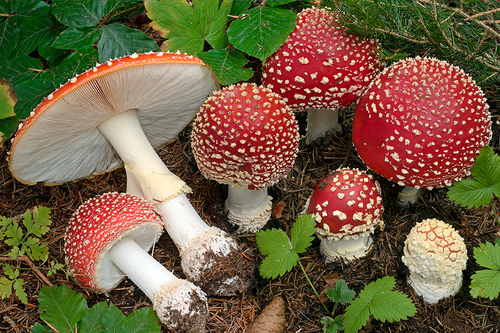
Identification: Classic form: scarlet red cap with white warts. Gills white, free. Ring white, pendant. Stem white with a bulbous base. Spore print white.
Look-alike Risks:
- Mainstream Risk: Misidentified as edible orange-capped species including golden chanterelles or Caesar's mushroom (Amanita caesarea). Key difference: chanterelles have forked ridges (not true gills); A. caesarea has orange gills; A. muscaria has white gills and a distinct ring and volva.
- Arctic Bleaching Risk: Intense UV radiation and harsh weather in high-latitude tundra washes away the red pigment of Amanita muscaria, leaving a bleached pale orange or completely white morphotype (Amanita muscaria var. alba). Foragers mistake these for edible Field or Horse Mushrooms (Agaricus species). Diagnostic difference: Agaricus species develop dark chocolate-brown to black gills at maturity; Arctic Amanita morphotypes maintain persistently white to cream gills throughout their lifecycle and yield a white spore print. Agaricus yields a chocolate-brown spore print.
Symptoms: Identical toxidrome to A. pantherina: rapid onset hallucinations, delirium, alternating excitation and deep somnolence. A. pantherina is considered more dangerous due to higher muscimol/ibotenic acid content relative to body weight.
Atropine is absolutely contraindicated for the same reasons as A. pantherina. Negligible muscarine — atropine will severely exacerbate the CNS excitation phase.
Onset: Hyper-acute — typically 15 to 30 minutes post-ingestion
SLUDGE Syndrome:
- Salivation (profuse drooling)
- Lacrimation (excessive tearing)
- Urination
- Defecation
- Gastrointestinal distress (severe abdominal cramping)
- Emesis (violent vomiting)
Accompanying signs: Profuse diaphoresis (sweating), bradycardia (dangerously low heart rate), bronchospasm, extreme miosis (pinpoint pupils)
Adult dosing: 1–2 mg IV (or IM if IV access delayed). Repeat every 5–10 minutes until clinical endpoints achieved.
Pediatric dosing: 0.02 mg/kg IV (minimum single dose 0.1 mg to avoid paradoxical bradycardia; maximum single titration dose 0.5 mg). Repeat every 5–10 minutes until clinical endpoints achieved.
Critical clinical endpoints — titrate ONLY until:
- Bronchial secretions dry up (lungs clear to auscultation)
- Bradycardia resolves (HR > 80 bpm)
Do NOT titrate based on pupil dilation or dry mouth. Aggressive titration to these endpoints prevents asphyxiation from bronchorrhea.
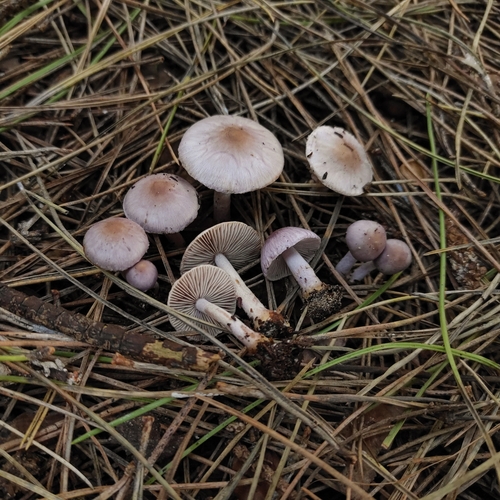
Identification: Small, white to cream, funnel-shaped cap (3–5 cm diameter). Cap surface smooth, mealy. Gills white, crowded, decurrent (running down the stem). Stem thin, white, with a mealy smell. Spore print white.
Note: This protocol applies identically to Clitocybe rivulosa (Frosted Funnel) and toxic white Inocybe species — all are high-muscarine fungi requiring identical management.
Look-alike Risks:
- Mainstream Risk: Misidentified as small white meadow mushrooms or Marasmius oreades (Fairy Ring Champignon). Key difference: Marasmius oreades cap has a broad, low umbo at center and its gills are well-spaced (not crowded); it has a pleasant sweet or almond-like scent. Clitocybe dealbata has crowded decurrent gills and a mealy smell.
- Arctic Tundra Risk: White funnel-shaped Clitocybe species thrive in Arctic grasslands and mossy tundra; foragers frequently confuse them with early-season specimens of edible St. George's Mushroom (Calocybe gambosa). Diagnostic difference: edible Calocybe gambosa is thick-fleshed and carries a strong distinct odor of fresh flour or cucumber skin (farinaceous); toxic Clitocybe species are thin-fleshed, brittle, and smell faintly sweet or completely neutral.
Symptoms: SLUDGE syndrome onset 15–30 minutes: profuse salivation, lacrimation, urination, defecation, GI cramping, vomiting. Diaphoresis (profuse sweating), bradycardia, bronchospasm, pinpoint pupils (extreme miosis).
Adult: 1–2 mg IV, repeat every 5–10 min. Pediatric: 0.02 mg/kg IV, repeat until endpoints achieved. Titrate to drying of bronchial secretions and resolution of bradycardia (HR > 80 bpm). Additional supportive care: IV fluids, airway management, oxygen.
Isoxazole Poisoning — Amanita muscaria / Amanita pantherina
Clinical signs: Ataxia ("drunk walking"), muscle tremors, snapping at invisible objects, alternating excitement and profound lethargy, bradycardia, respiratory depression. Onset 30 minutes to 2 hours.
Management:
- DO NOT give atropine — contraindicated for the same reasons as in humans
- Provide quiet, dark, padded housing to prevent self-injury during excitation phase
- Administer fluid therapy to support elimination
- If seized or severely agitated, cautious veterinary sedation (Diazepam or Midazolam)
Muscarine Poisoning — Clitocybe species
Clinical signs: Vomiting, watery diarrhea, severe hypersalivation (drooling), pinpoint pupils, tear production, bradycardia. Onset 15 to 30 minutes.
Management:
- Atropine Sulfate 0.02–0.04 mg/kg IV or IM. Repeat until hypersalivation ceases and bronchial secretions clear.
- Aggressive IV fluid therapy to combat dehydration