About This Guide
This guide covers the 2 most clinically significant toxic mushroom species in Western & Eastern Siberia, with a focus on gyromitrin-mediated GABA synthesis inhibition and monomethylhydrazine (MMH) toxicity. Both Gyromitra esculenta (Строчок обыкновенный) and Gyromitra gigas (Строчок гигантский) are Tier 1 — lethal risk species, responsible for fatal hepatotoxic and neurological poisoning across Siberian foraging regions every spring.
Critical diagnostic challenge: False morels are visually similar to edible true morels (Morchella species) and are harvested in the same spring season. A definitive bisect test is the primary field diagnostic. Additionally, the gyromitrin toxin volatilizes into MMH gas when cooked — a serious inhalation hazard documented to poison cooks before anyone eats.
Emergency contacts (tap to call): Emergency 112 • Ambulance 103 • Moscow Poison Control +7 (495) 628-16-87
Quick Reference — Both Species
| Species | Common Name | Tier | Toxin | Onset | Primary Risk |
|---|---|---|---|---|---|
| Gyromitra esculenta | False Morel / Строчок обыкновенный | Tier 1 | Gyromitrin → MMH | 6–12 hrs | Lethal hepatotoxicity, neurological failure, methemoglobinemia |
| Gyromitra gigas | Snow False Morel / Строчок гигантский | Tier 1 | Gyromitrin → MMH | 6–12 hrs | Lethal hepatotoxicity, neurological failure, methemoglobinemia |
Clinical Timeline — Gyromitrin / MMH Toxidrome
Latent Phase (6–12 hours): Gyromitrin is hydrolyzed in the gut to N-methyl-N-formylhydrazine and then to monomethylhydrazine (MMH). MMH inhibits pyridoxal phosphate, blocking GABA synthesis and disrupting multiple enzyme systems. Initial symptom-free window.
Neurological Phase (12–24 hours): Severe headache, dizziness, progressive ataxia, tonic-clonic seizures, confusion. GABA depletion drives neurological excitability. IV pyridoxine (Vitamin B6) is the antidote for seizures — it restores pyridoxal phosphate activity.
Systemic Phase (2–4 days): Hemolytic anemia, methemoglobinemia (treat with methylene blue), direct hepatotoxicity with elevated ALT/AST, jaundice, and potential hepatic failure. Renal failure secondary to hemoglobin nephropathy.
Veterinary (Dogs & Cats): Onset 6–12 hours. Vomiting, hemolytic anemia, jaundice, seizures. High mortality in severe exposures. Methylene blue, pyridoxine, supportive care.
Cut the mushroom vertically from cap tip to stem base. This is the single most reliable field test to distinguish true morels from false morels. Do NOT rely on cap color or surface texture alone.
- True Morel (Morchella): A single, completely open hollow room from cap tip to stem base. One continuous empty chamber. Walls are thin. Cap pits are fully integrated with the hollow interior.
- False Morel (Gyromitra): Chambered, webbed, or packed with fleshy folds. Multiple pockets and internal attachment points. NOT one open space — the interior is a dense, marbled, or cottony-stuffed maze.
If in any doubt — do not eat. The bisect test is definitive. Any mushroom that is not a single open hollow room should be treated as false morel and discarded.
Vertical Cross-Section Comparison — Morchella vs. Gyromitra
| Feature | True Morel (Morchella) | False Morel (Gyromitra) |
|---|---|---|
| Interior Cavity | Completely hollow from cap tip to stem base | Chambered, webbed, or packed with fleshy folds |
| Interior Space | Single continuous open "room" | Dense, marbled, or cottony-stuffed maze |
| Cap Attachment | Cap wall transitions continuously into stem | Cap folds over and attaches at margins and along internal points |
Gyromitrin has a low boiling point and is highly volatile. When false morels are boiled, gyromitrin is hydrolyzed directly into monomethylhydrazine (MMH) gas — the same compound used as liquid rocket propellant in aerospace applications.
Inhaling cooking steam causes rapid systemic MMH poisoning via direct pulmonary absorption, completely bypassing the digestive tract. This is faster and more dangerous than ingestion poisoning because there is no GI latency — MMH enters the bloodstream immediately through the lungs.
Historical documented cases: Multiple Russian and Scandinavian cases involve the cook becoming violently ill — dizziness, severe headache, confusion, vomiting — before anyone at the table has eaten anything. The cook absorbs a lethal or near-lethal dose through respiratory exposure alone.
Ventilation requirement: Parboiling (if attempted as a traditional toxin-reduction method) MUST be performed outdoors or under high-efficiency industrial exhaust ventilation. Standard kitchen range hood fans are completely insufficient to remove MMH concentrations produced by boiling false morels. Indoor parboiling in a standard kitchen is dangerous even with windows open.
Clinical note for first responders: If a patient presents with rapid-onset neurological symptoms (headache, confusion, ataxia) after cooking but reports they did not eat mushrooms — ask about proximity to boiling false morels. Inhalation poisoning has the same MMH toxidrome as ingestion.
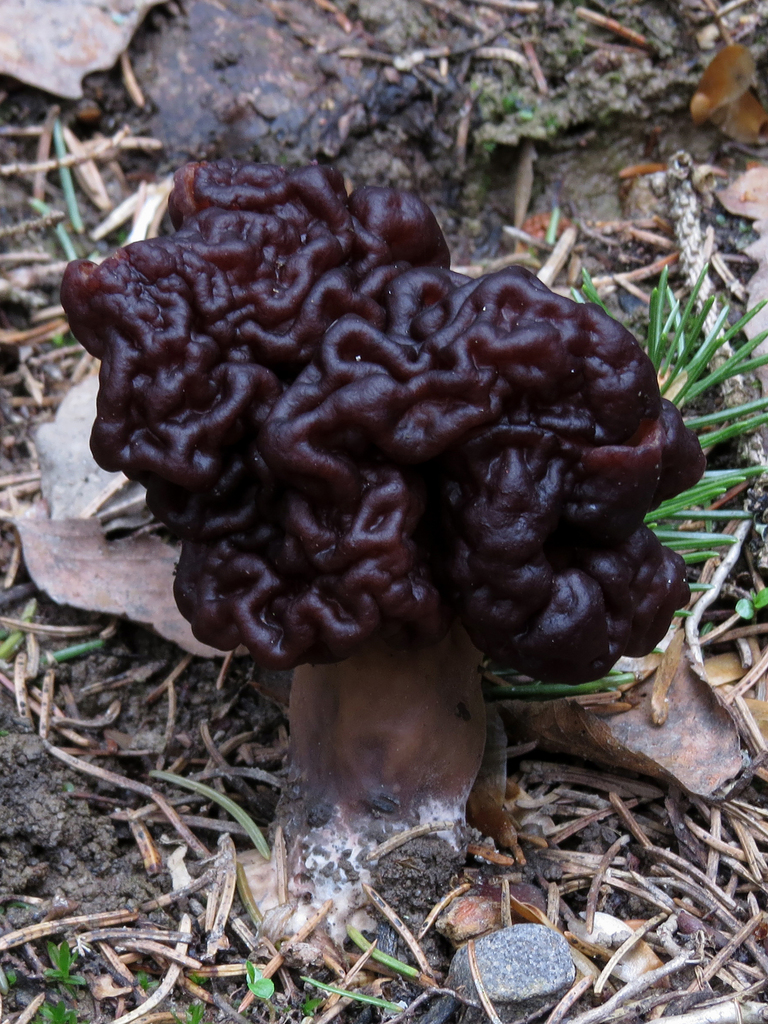
Identification: Cap irregularly brain-like, saddle-shaped or deeply lobed, reddish-brown to dark brown — resembling a convoluted brain mass. Cap surface is cerebral and wrinkled, NOT pitted like a true morel. Cap IS attached to the stem at the margins and at various internal points — this distinguishes it from Verpa/Helvella species where the cap hangs free. Stem is stout, whitish to pale, chambered and multi-pocketed with fleshy internal folds — NOT a single hollow chamber.
Look-alike risk: Commonly misidentified as true morels (Morchella species) — both are spring mushrooms, both are large, and both appear in similar habitats. Key distinctions: true morel has a honeycomb-pitted cap, completely hollow interior; false morel has a brain-wrinkled cap, chambered/stuffed interior. The bisect test is definitive.
Symptoms: Headache, nausea, vomiting, diarrhea (6–12 hrs) → tonic-clonic seizures, ataxia, confusion (12–24 hrs) → hemolytic anemia, methemoglobinemia, jaundice, hepatic failure, renal failure (2–4 days).
Treatment:
- IV Pyridoxine (Vitamin B6) — antidote for MMH-induced seizures; restores pyridoxal phosphate activity and GABA synthesis
- Methylene blue — for methemoglobinemia (administer cautiously, standard dosing)
- Aggressive supportive care — IV fluids, antiemetics, airway management
- Liver function monitoring — serial ALT, AST, bilirubin, coagulation studies
- Nephrology consultation if hemoglobin nephropathy develops

Identification: The largest Gyromitra species. Cap pale tan to yellowish-brown, massive compared to G. esculenta. Thick, heavily ribbed white stem. Cap surface is brain-like and deeply convoluted. Fruits characteristically next to melting snowbanks in early spring — one of the first mushrooms to appear as snow recedes.
Variable toxin concentration: Gyromitrin concentration in G. gigas varies wildly by season, microclimate, and geographic location. A specimen collected early in the season near a cold snowbank may contain dramatically different toxin levels than one collected later in warmer conditions. This variability must NOT be interpreted as reduced risk. Every specimen must be treated with identical clinical gravity as G. esculenta.
Look-alike risk: May be confused with true morels (Morchella spp.) appearing near snowmelt. Bisect test is definitive — G. gigas will show chambered, multi-pocketed interior. Also confused with G. esculenta by foragers who do not recognize them as separate species; both are equally toxic and carry identical treatment protocols.
Treatment: Identical to Gyromitra esculenta above. IV Pyridoxine for seizures, methylene blue for methemoglobinemia, aggressive supportive care, liver monitoring.
🐾 Veterinary — Dogs & Cats
Toxin: Gyromitrin / MMH — same mechanism as human poisoning.
Onset: 6–12 hours.
Symptoms: Vomiting, hemolytic anemia, jaundice, seizures. Progression to hepatic and renal failure in severe exposures.
Treatment: Methylene blue (for methemoglobinemia), pyridoxine (for seizures), aggressive supportive care including IV fluids and antiemetics. High mortality in severe exposures — urgent veterinary care required.
Note for clinicians: If a household pet presents with these symptoms in spring, ask whether the household was cooking or harvesting mushrooms. Inhalation exposure is possible for animals in the kitchen during parboiling.