⚠ Medical Disclaimer: This guide is for educational purposes and field reference only. It does not replace professional medical advice, diagnosis, or treatment. In any suspected snakebite emergency, call 911 and contact Poison Control at 1-800-222-1222 immediately. Always follow the judgment of on-scene medical professionals.
Section 1 — Venom Classification Overview
🩸 HEMOTOXIC
Pit Vipers — all rattlesnakes, copperhead, cottonmouth
- Mechanism: Phospholipases, proteases, hyaluronidase destroy tissue and coagulation cascade
- Onset: Symptoms within 15–30 minutes; coagulopathy within 1–2 hours
- DIC risk: Fibrinogen depletion, thrombocytopenia, elevated PT/PTT
- Local signs: Rapid swelling, ecchymosis, hemorrhagic bullae, necrosis
⚡ KEY RULE: Do NOT wait for systemic symptoms before transport — local swelling alone is an indication for antivenom evaluation.
🧠 NEUROTOXIC
Coral Snakes — Micrurus species
- Mechanism: Postsynaptic acetylcholine receptor blockade → descending flaccid paralysis
- Onset: Delayed 1–12 hours; bite may appear minor with minimal local reaction
- Latency trap: Patient feels fine for hours then deteriorates rapidly
- Primary cause of death: Respiratory muscle paralysis
⚡ KEY RULE: Transport immediately even if patient feels completely fine. Airway management is priority — respiratory failure can occur hours after bite.
Section 2 — Species Clinical Cards
Hemotoxic — Pit Vipers
Rattlesnakes, Copperhead & Cottonmouth
All produce hemotoxic venom with local tissue destruction, coagulopathy, and systemic effects. CroFab or Anavip antivenom. Transport immediately — do not wait for systemic symptoms.
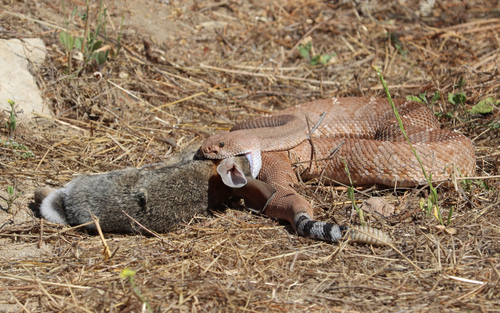
Western Diamondback Rattlesnake
Crotalus atrox
Hemotoxic — Pit Viper
Southwest · Texas · Oklahoma · New Mexico · Arizona · California (desert)
Field Identification
Diamond pattern on back, black and white banded tail ('coontail rattler'), triangular head, heat-sensing pits between eye and nostril, rattle present. 3.5–5 ft average length.
Clinical Presentation
Immediate burning pain, rapid edema from bite site, ecchymosis within 30–60 min, hemorrhagic bullae, coagulopathy (fibrinogen depletion), thrombocytopenia, DIC in severe cases, hypotension, nausea, vomiting. Swelling can progress up entire limb within 2–4 hours.
Symptom Timeline
- 0–30 min: Local pain, swelling begins
- 1–2 hr: Edema spreading, early coagulopathy
- 2–6 hr: Bullae formation, systemic symptoms
- 6–24 hr: Peak coagulopathy, DIC risk
✓ Field DO
- Call 911 immediately
- Immobilize bitten limb at or below heart level
- Remove rings, watches, tight clothing before swelling begins
- Mark swelling edge with pen every 15 min, note time
- Keep patient calm and still — movement accelerates venom spread
- Note exact time of bite
- Photograph snake from safe distance if possible (do NOT handle)
- Transport to nearest emergency facility immediately
✗ Field DO NOT
- No tourniquet — worsens necrosis and outcome
- No incision at bite site — increases infection risk
- No suction (Sawyer or mouth) — negligible venom removal
- No ice or cold water — accelerates tissue damage
- No alcohol — vasodilates, accelerates absorption
- No aspirin/NSAIDs — worsens coagulopathy
- No electric shock — no evidence, causes injury
- No wait-and-see — transport even if patient feels fine
Hospital Management
CroFab (Crotalidae Polyvalent Immune Fab): Initial 4–6 vials IV in 250 mL NS over 60 min. Titrate to clinical response. Repeat 2-vial maintenance doses at 6, 12, 18 hr if coagulopathy recurs. Monitor CBC, PT/PTT, fibrinogen q2–4h.
Anavip (Crotalidae Immune F(ab')2): Approved 2015. 10 vials initial dose. Superior fibrinogen recovery, longer half-life. Less recurrent coagulopathy.
Anavip (Crotalidae Immune F(ab')2): Approved 2015. 10 vials initial dose. Superior fibrinogen recovery, longer half-life. Less recurrent coagulopathy.
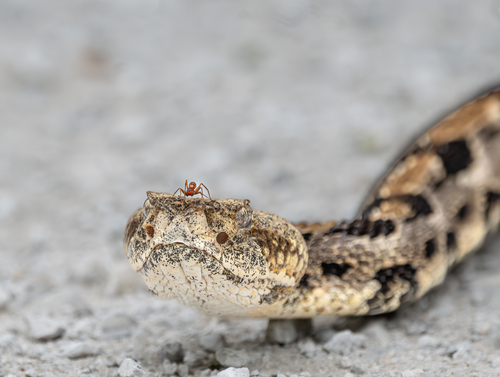
Timber Rattlesnake
Crotalus horridus
Hemotoxic — Pit Viper
Northeast · Mid-Atlantic · Southeast · Appalachian forests · Midwest (southern)
Field Identification
Heavy-bodied, gray or yellow-brown with dark chevron crossbands, rust-colored dorsal stripe, black tail, rattle. 3–5 ft. Found in rocky ridges, hardwood forest, wetland edges — prime mushroom foraging terrain.
Clinical Presentation
Severe local pain and swelling, ecchymosis, coagulopathy. Southern 'canebrake' populations may cause myokymia, fasciculations, and neurologic symptoms in addition to hemotoxic picture (Mojave toxin variant). Myonecrosis in severe cases.
Symptom Timeline
- 0–30 min: Pain, early swelling
- 1–4 hr: Rapid edema, early coagulopathy
- 4–12 hr: Peak swelling, hemorrhagic bullae, systemic coagulopathy
- 2–6 hr (SE pop.): Neurologic symptoms (myokymia, fasciculations) possible in southern populations
✓ Field DO
- Call 911 immediately
- Immobilize bitten limb at or below heart level
- Remove rings, watches, tight clothing before swelling begins
- Mark swelling edge with pen every 15 min, note time
- Keep patient calm and still — movement accelerates venom spread
- Note exact time of bite
- Photograph snake from safe distance if possible (do NOT handle)
- Transport to nearest emergency facility immediately
✗ Field DO NOT
- No tourniquet — worsens necrosis and outcome
- No incision at bite site — increases infection risk
- No suction (Sawyer or mouth) — negligible venom removal
- No ice or cold water — accelerates tissue damage
- No alcohol — vasodilates, accelerates absorption
- No aspirin/NSAIDs — worsens coagulopathy
- No electric shock — no evidence, causes injury
- No wait-and-see — transport even if patient feels fine
Hospital Management
CroFab: 4–6 vials initial. For patients bitten in Southeast/Gulf states, monitor for neurotoxic signs (myokymia, fasciculations, neurologic symptoms). If neurotoxic signs present, consider higher initial dosing 6–8 vials. Note: neurotoxic component of canebrake venom is not well reversed by CroFab — supportive airway management may be needed.
⚠ Southern canebrake populations carry Mojave toxin variant — consider neurotoxic workup for any Southeast Timber Rattlesnake bite.
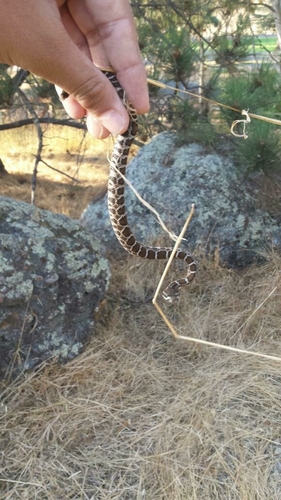
Prairie Rattlesnake
Crotalus viridis
Hemotoxic — Pit Viper
Great Plains · Rocky Mountain foothills · MT · WY · CO · KS · NE · ND · SD
Field Identification
Greenish-brown to gray with rounded brown blotches, pale border on blotches, rattle. 2.5–4 ft. Common in open grasslands and prairie — frequently encountered by berry pickers and plant foragers.
Clinical Presentation
Moderate to severe local reaction, edema, ecchymosis, coagulopathy. Generally considered less severe than Western Diamondback but significant envenomations occur. Nausea, vomiting, hypotension in systemic cases.
Symptom Timeline
- 0–30 min: Local pain, swelling begins
- 1–3 hr: Progressive edema
- 3–12 hr: Coagulopathy develops, systemic symptoms
✓ Field DO
- Call 911 immediately
- Immobilize bitten limb at or below heart level
- Remove rings, watches, tight clothing before swelling begins
- Mark swelling edge with pen every 15 min, note time
- Keep patient calm and still — movement accelerates venom spread
- Note exact time of bite
- Photograph snake from safe distance if possible (do NOT handle)
- Transport to nearest emergency facility immediately
✗ Field DO NOT
- No tourniquet — worsens necrosis and outcome
- No incision at bite site — increases infection risk
- No suction (Sawyer or mouth) — negligible venom removal
- No ice or cold water — accelerates tissue damage
- No alcohol — vasodilates, accelerates absorption
- No aspirin/NSAIDs — worsens coagulopathy
- No electric shock — no evidence, causes injury
- No wait-and-see — transport even if patient feels fine
Hospital Management
CroFab: 4–6 vials initial IV over 60 min. Titrate to clinical response. Repeat maintenance dosing per protocol. Monitor CBC, PT/PTT, fibrinogen q2–4h.
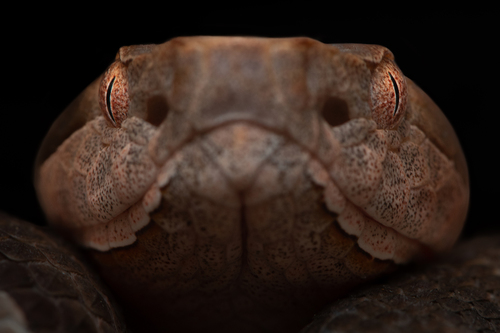
Copperhead
Agkistrodon contortrix
Hemotoxic — Pit Viper
Southeast · Mid-Atlantic · Northeast (southern) · Midwest · Texas · Oklahoma — most common venomous snakebite in eastern US
Field Identification
Hourglass-shaped copper-brown crossbands on tan/brown body, unmarked copper-colored head, no rattle. 2–3 ft. Found in rocky hillsides, leaf litter, stone walls, rotting logs — extremely common in mushroom foraging habitat.
Clinical Presentation
Immediate pain, local edema, ecchymosis. Rarely causes systemic coagulopathy or DIC. Myotoxicity reported. Most envenomations cause significant local tissue damage but are rarely fatal in healthy adults. Children and elderly at higher risk for systemic effects.
Symptom Timeline
- 0–30 min: Pain, swelling begins
- 1–4 hr: Edema spreads
- 4–24 hr: Peak local effects, ecchymosis, possible bullae. Systemic symptoms uncommon but monitor.
✓ Field DO
- Call 911 immediately
- Immobilize bitten limb at or below heart level
- Remove rings, watches, tight clothing before swelling begins
- Mark swelling edge with pen every 15 min, note time
- Keep patient calm and still — movement accelerates venom spread
- Note exact time of bite
- Photograph snake from safe distance if possible (do NOT handle)
- Transport to nearest emergency facility immediately
✗ Field DO NOT
- No tourniquet — worsens necrosis and outcome
- No incision at bite site — increases infection risk
- No suction (Sawyer or mouth) — negligible venom removal
- No ice or cold water — accelerates tissue damage
- No alcohol — vasodilates, accelerates absorption
- No aspirin/NSAIDs — worsens coagulopathy
- No electric shock — no evidence, causes injury
- No wait-and-see — transport even if patient feels fine
Hospital Management
CroFab: Indicated for progressive swelling, systemic symptoms, or significant coagulopathy. Many mild copperhead bites managed supportively without antivenom. If antivenom indicated: initial dose 4–6 vials. Observe minimum 8–12 hours. Copperhead bites frequently treated conservatively — but always transport for evaluation.
Note: copperhead is the most common venomous snakebite in eastern US and extremely common in mushroom foraging habitat (leaf litter, rotting logs, stone walls). Always transport — even 'mild' bites require evaluation.
Cottonmouth (Water Moccasin)
Agkistrodon piscivorus
Hemotoxic — Pit Viper
Southeast · Gulf Coast · Mississippi Valley · Florida · Eastern Texas · Oklahoma · Virginia · Missouri — always near water
Field Identification
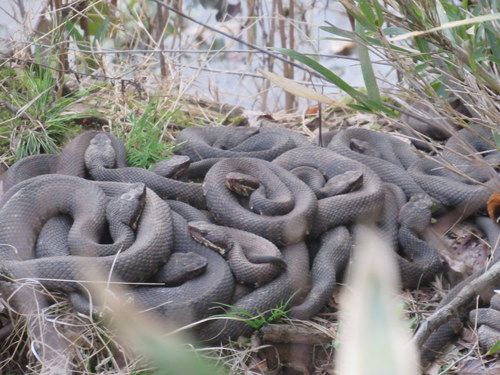
Heavy-bodied, dark brown to black, white cotton interior of mouth displayed as threat response (distinctive). Triangular head, heat-sensing pits. 2–4 ft. Found at water's edge — common near watercress, cattail, elderberry.
Clinical Presentation
Severe local tissue destruction, edema, hemorrhagic bullae, significant myonecrosis. Considered more cytotoxic than copperhead. Coagulopathy common. Systemic symptoms including hypotension, nausea, vomiting. High infection risk.
Symptom Timeline
- 0–30 min: Immediate severe pain, rapid swelling
- 1–3 hr: Hemorrhagic bullae, edema spreading rapidly
- 3–12 hr: Myonecrosis, coagulopathy, systemic symptoms
✓ Field DO
- Call 911 immediately
- Immobilize bitten limb at or below heart level
- Remove rings, watches, tight clothing before swelling begins
- Mark swelling edge with pen every 15 min, note time
- Keep patient calm and still — movement accelerates venom spread
- Note exact time of bite
- Photograph snake from safe distance if possible (do NOT handle)
- Transport to nearest emergency facility immediately
- Get out of water immediately — secondary drowning risk during envenomation
✗ Field DO NOT
- No tourniquet — worsens necrosis and outcome
- No incision at bite site — increases infection risk
- No suction (Sawyer or mouth) — negligible venom removal
- No ice or cold water — accelerates tissue damage
- No alcohol — vasodilates, accelerates absorption
- No aspirin/NSAIDs — worsens coagulopathy
- No electric shock — no evidence, causes injury
- No wait-and-see — transport even if patient feels fine
Hospital Management
CroFab: 4–6 vials initial; higher doses may be needed for severe envenomations. Fasciotomy rarely indicated — avoid unless confirmed compartment syndrome with measured pressures >30 mmHg. Wound care critical due to high infection risk.
Neurotoxic — Coral Snakes
Micrurus Species — Eastern & Texas Coral Snakes
Bite may appear trivial. Critical latency trap: patient feels fine for hours then deteriorates rapidly. Transport immediately even without symptoms. Antivenom supply is limited — contact Poison Control at once.
Eastern Coral Snake
Micrurus fulvius
Neurotoxic — Coral Snake
Southeast — Florida · Georgia · South Carolina · North Carolina · Mississippi · Alabama · Louisiana
Field Identification
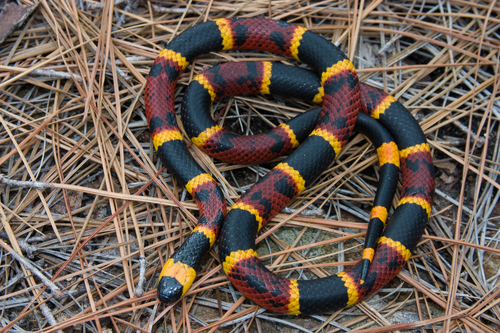
Bright red, yellow, and black bands — RED TOUCHES YELLOW (kills a fellow). Distinguished from harmless scarlet kingsnake by band order. Small head, round pupils, 20–30 inches. Secretive — found under leaf litter and logs, prime mushroom habitat.
Clinical Presentation
Bite may appear trivial — small punctures, minimal local reaction, no significant swelling. Patient may feel completely fine for 1–12 hours. Then: descending flaccid paralysis, ptosis, diplopia, dysarthria, dysphagia, respiratory muscle paralysis. Respiratory failure is the cause of death. Once paralysis begins it is extremely difficult to reverse even with antivenom.
Symptom Timeline
- 0–2 hr: Minimal symptoms — false reassurance period
- 2–6 hr: Cranial nerve palsies begin: ptosis, diplopia
- 6–12 hr: Bulbar symptoms: dysarthria, dysphagia
- 12–24 hr: Respiratory failure risk — mechanical ventilation may be required
✓ Field DO
- Call 911 immediately
- Immobilize bitten limb at or below heart level
- Remove rings, watches, tight clothing before swelling begins
- Mark swelling edge with pen every 15 min, note time
- Keep patient calm and still — movement accelerates venom spread
- Note exact time of bite
- Photograph snake from safe distance if possible (do NOT handle)
- Transport to nearest emergency facility immediately
- CRITICAL: transport immediately even if patient feels completely fine — do not wait for symptoms
- Airway equipment should be ready en route
✗ Field DO NOT
- No tourniquet — worsens necrosis and outcome
- No incision at bite site — increases infection risk
- No suction (Sawyer or mouth) — negligible venom removal
- No ice or cold water — accelerates tissue damage
- No alcohol — vasodilates, accelerates absorption
- No aspirin/NSAIDs — worsens coagulopathy
- No electric shock — no evidence, causes injury
- No wait-and-see — transport even if patient feels fine
Hospital Management
North American Coral Snake Antivenin (Wyeth): Manufacturer discontinued — LIMITED SUPPLY. Contact Poison Control (1-800-222-1222) for current availability and nearest stockpile location.
Dose: 3–5 vials IV if envenomation confirmed or strongly suspected. Administer prophylactically — do not wait for neurologic symptoms. Once paralysis begins antivenom is less effective.
Mechanical ventilation may be required for days to weeks. No FDA-approved alternative currently available in US — clinical trials ongoing.
Dose: 3–5 vials IV if envenomation confirmed or strongly suspected. Administer prophylactically — do not wait for neurologic symptoms. Once paralysis begins antivenom is less effective.
Mechanical ventilation may be required for days to weeks. No FDA-approved alternative currently available in US — clinical trials ongoing.
⚠ CRITICAL LATENCY TRAP: patient appears fine for 1–12 hours then deteriorates rapidly. Prophylactic antivenom is recommended — do not wait for symptoms. Airway is the priority.
Texas Coral Snake
Micrurus tener
Neurotoxic — Coral Snake
Texas · Western Louisiana · Arkansas (southern) · Oklahoma (southeastern)
Field Identification
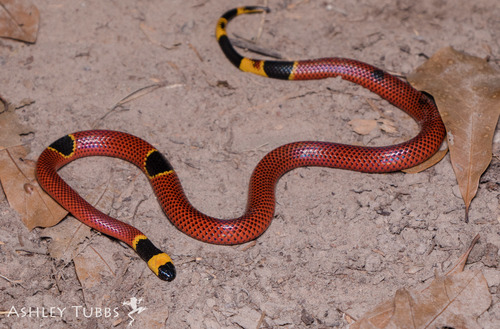
Same red-yellow-black banding as Eastern Coral Snake — RED TOUCHES YELLOW. Slightly smaller, 20–24 inches. Found in dry rocky areas, wooded hillsides, and brush — different habitat than Eastern Coral Snake.
Clinical Presentation
Same neurotoxic presentation as Eastern Coral Snake — descending flaccid paralysis, respiratory failure. Same latency trap — bite appears minor, patient deteriorates hours later.
Symptom Timeline
- 0–2 hr: Minimal symptoms — false reassurance period
- 2–6 hr: Cranial nerve palsies begin: ptosis, diplopia
- 6–12 hr: Bulbar symptoms: dysarthria, dysphagia
- 12–24 hr: Respiratory failure risk — mechanical ventilation may be required
✓ Field DO
- Call 911 immediately
- Immobilize bitten limb at or below heart level
- Remove rings, watches, tight clothing before swelling begins
- Mark swelling edge with pen every 15 min, note time
- Keep patient calm and still — movement accelerates venom spread
- Note exact time of bite
- Photograph snake from safe distance if possible (do NOT handle)
- Transport to nearest emergency facility immediately
- CRITICAL: transport immediately even if patient feels completely fine
- Airway equipment should be ready en route
✗ Field DO NOT
- No tourniquet — worsens necrosis and outcome
- No incision at bite site — increases infection risk
- No suction (Sawyer or mouth) — negligible venom removal
- No ice or cold water — accelerates tissue damage
- No alcohol — vasodilates, accelerates absorption
- No aspirin/NSAIDs — worsens coagulopathy
- No electric shock — no evidence, causes injury
- No wait-and-see — transport even if patient feels fine
Hospital Management
Same antivenom supply crisis as Eastern Coral Snake. Contact Poison Control (1-800-222-1222) immediately for current availability. Anascorp (centruroides scorpion antivenom) does NOT cross-react — do not substitute. Supportive mechanical ventilation may be needed for days to weeks.
⚠ Same critical transport urgency as Eastern Coral Snake. Prophylactic antivenom even before symptoms develop. Airway management is priority.
Section 3 — Regional Distribution
| Region | Species Present |
|---|---|
| Northeast | Timber Rattlesnake, Copperhead |
| Mid-Atlantic | Timber Rattlesnake, Copperhead, Cottonmouth (southern) |
| Southeast | Timber Rattlesnake, Copperhead, Cottonmouth, Eastern Coral Snake |
| Florida | Cottonmouth, Eastern Coral Snake, Dusky Pygmy Rattlesnake |
| Gulf Coast | Cottonmouth, Eastern Coral Snake, Western Diamondback (western) |
| Midwest | Timber Rattlesnake (southern), Copperhead (southern), Prairie Rattlesnake (western) |
| Great Plains | Prairie Rattlesnake |
| Southwest | Western Diamondback, Prairie Rattlesnake |
| Texas | Western Diamondback, Copperhead, Cottonmouth, Texas Coral Snake |
| Pacific Northwest | Western Rattlesnake (Crotalus oreganus — not covered in this guide) |
| Rocky Mountains | Prairie Rattlesnake |
Section 4 — Universal Field Response Protocol
🐍 Field Response — ALL Venomous Snakebite
✓ DO
- Call 911 or Poison Control (1-800-222-1222) immediately
- Stay calm and keep patient as still as possible — movement accelerates venom spread
- Immobilize bitten limb at or slightly below heart level
- Remove rings, watches, tight clothing, and footwear from bitten limb before swelling begins
- Mark leading edge of swelling with pen every 15 minutes with time noted
- Note exact time of bite
- Photograph snake from safe distance if possible — do NOT handle it (dead snakes can envenomated via reflex bite for up to 1 hour)
- Transport to nearest emergency facility immediately — do not drive yourself
✗ DO NOT
- No tourniquet — concentrates venom, causes necrosis, worsens outcome
- No incision at bite site — increases infection, does not remove venom
- No suction (Sawyer extractor or mouth) — negligible venom removal, increases infection
- No ice or cold water — causes additional vasoconstriction and tissue damage
- No alcohol — vasodilates, accelerates venom absorption
- No aspirin or NSAIDs — worsens coagulopathy
- No electric shock — no scientific basis, causes additional injury
- No wait-and-see — transport immediately even if patient feels fine (especially coral snakes)
Poison Control: 1-800-222-1222 — 24/7, free, expert guidance
Section 5 — Hospital Management & Antivenom Protocols
CroFab® — Crotalidae Polyvalent Immune Fab
Pit Viper Antivenom (rattlesnakes, copperhead, cottonmouth)
Indications
Progressive local swelling, coagulopathy, systemic symptoms
Initial Dose
4–6 vials IV in 250 mL NS over 60 minutes
Response Endpoint
Arrest of local progression, correction of coagulopathy, improvement of systemic symptoms
Maintenance
2 vials IV at 6, 12, and 18 hours after initial control achieved
Lab Monitoring
CBC, PT/PTT, INR, fibrinogen, BMP every 2–4 hours for first 24 hours
Recurrent Coagulopathy
May occur 2–14 days post-envenomation — outpatient follow-up essential
Anavip® — Crotalidae Immune F(ab')2
Alternative Pit Viper Antivenom — FDA approved 2015
Initial Dose
10 vials IV
Advantages
Longer half-life, superior fibrinogen recovery in clinical trials, less recurrent coagulopathy vs CroFab
Recurrent Coagulopathy
Less common than with CroFab due to longer half-life
North American Coral Snake Antivenin (Wyeth)
Neurotoxic Coral Snake Antivenom — LIMITED SUPPLY
⚠ SUPPLY CRISIS: Wyeth discontinued production. Contact Poison Control (1-800-222-1222) immediately for current availability and nearest stockpile location.
Dose
3–5 vials IV if envenomation confirmed or strongly suspected
Timing
Administer prophylactically — do NOT wait for neurologic symptoms. Once paralysis established, antivenom is less effective.
Supportive Care
Airway management is priority. Mechanical ventilation may be required for days to weeks. No reversal agent once paralysis established.
Alternative
No FDA-approved alternative currently available in US. Clinical trials ongoing. Anascorp does NOT cross-react.
Section 6 — Myth Busting
| Myth | Reality |
|---|---|
| Cut and suck out the venom | No evidence of efficacy; creates infection risk, delays transport |
| Tourniquet stops venom spread | Concentrates venom locally, causes tissue necrosis, worsens outcome |
| Alcohol neutralizes venom | Vasodilation accelerates venom absorption into bloodstream |
| Ice slows venom | Cold causes additional vasoconstriction and tissue damage |
| Electric shock deactivates venom | No scientific basis; causes burns and additional injury |
| Dead snake is safe | Decapitated snake heads can envenomated by reflex bite for up to an hour |
| Small snake = less dangerous | Juvenile rattlesnakes can deliver full venom loads |
| Coral snakes are not dangerous | Most lethal US snake by venom toxicity; bite appears minor then causes respiratory failure |
| Sawyer pump removes venom | Clinical studies show negligible venom removal, increases infection risk |
| Running helps dilute the venom | Activity increases heart rate and accelerates systemic venom spread |
Section 7 — Veterinary — Dogs in the Field
🐕 Dogs Are Frequent Snakebite Victims While Foraging with Owners
Key Differences from Human Envenomation
- Dogs are bitten on face and nose most often — rapid facial swelling, airway compromise risk
- Much smaller body mass — venom dose per kg is higher; smaller dogs have worse outcomes
- Copperhead bites most common in eastern US dogs
Symptoms to Watch For
Rapid facial swelling, yelping, drooling, lethargy, collapse
Field Response
- Immediate transport to veterinary emergency
- Carry your dog if possible — do not let them walk
- Keep dog as calm and still as possible
- Do NOT apply tourniquet or ice
Veterinary Treatment
Antivenom is available for dogs — Crotalidae Polyvalent Immune Fab (same as CroFab, FDA approved for veterinary use). Dog survival rates are high with prompt treatment. Delay is the primary risk factor for mortality.
Section 8 — Forager-Specific Encounter Scenarios by Terrain
🌲 Woodland / Forest Foraging (mushrooms, ramps, fiddleheads)
Primary Species
Timber Rattlesnake, Copperhead
Risk Behavior
Reaching into leaf litter, lifting logs and rocks, stepping over logs without looking, kneeling near rock outcroppings
Prevention
Wear leather boots above ankle; use a walking stick to probe ahead; never reach into a space you cannot see
🌾 Grassland / Prairie Foraging (berries, roots, greens)
Primary Species
Prairie Rattlesnake, Western Diamondback (southern)
Risk Behavior
Walking through tall grass without watching foot placement, sitting on the ground
Prevention
High boots, gaiters, snake chaps in high-risk areas; shuffle feet through grass rather than stepping high
💧 Waterside Foraging (watercress, cattail, elderberry)
Primary Species
Cottonmouth, Eastern Coral Snake (Southeast)
Risk Behavior
Reaching into water vegetation, stepping on muddy banks, reaching under overhanging vegetation at dusk
Prevention
Never reach into vegetation at water's edge without looking; probe with a stick first; be extra cautious at dusk when cottonmouths are most active
⛰️ Rocky Terrain / Hillside Foraging (morels, ramps, medicinal plants)
Primary Species
Western Diamondback, Timber Rattlesnake, Prairie Rattlesnake
Risk Behavior
Stepping on rocks without looking, reaching into rock crevices, sitting on warm rocks
Prevention
Look before you step on any rock; never put hands in rock crevices; snakes thermoregulate on warm rocks in the morning
🍂 Leaf Litter / Rotting Log Areas (mushrooms, truffles)
Primary Species
Copperhead, Eastern Coral Snake, Cottonmouth (Southeast)
Risk Behavior
Lifting logs and debris with bare hands
Prevention
Always flip logs away from you with a stick; wear gloves; look before kneeling; coral snakes are especially common under logs and leaf litter
🐍 Emergency? Poison Control: 1-800-222-1222 — 24/7, free, expert snakebite guidance
Photo credits: All species photographs sourced from iNaturalist under Creative Commons license (CC BY-NC). Taxonomy per iNaturalist research-grade observations.