5 Edible Mushrooms That Have Dangerous Look-Alikes (And How to Tell Them Apart)
Every mushroom hunting guide worth reading will tell you this: the forest is generous, but it demands respect. Several of the most beloved edible mushrooms have toxic or even deadly look-alikes that fool beginners and occasionally experienced foragers. This guide covers five confusion pairs — what makes them look similar, and the specific features that separate safe from dangerous.
1. Chanterelle vs. Jack-o'-Lantern Mushroom
The Edible: Golden Chanterelle (Cantharellus cibarius and related species)
Chanterelles are golden to egg-yolk yellow, funnel-shaped, and found singly or scattered on the forest floor — growing directly from the soil, often near oak, beech, or birch. They have a fruity, apricot-like aroma that's distinctive once you've smelled it. Their "gills" are actually false gills: blunt-edged, forking, shallow ridges that run partially down the stem. You cannot separate these ridges from the cap — they're not gills at all, just folds in the flesh.
The Look-Alike: Jack-o'-Lantern (Omphalotus olearius / O. illudens)
Jack-o'-lanterns are toxic and cause severe gastrointestinal distress. They're bright orange-yellow and can fool beginners from a distance — but the differences are clear on close inspection:
- True gills: Jack-o'-lanterns have sharp-edged, blade-like true gills that you can separate with a fingernail. Chanterelles have blunt, forking ridges.
- Cluster vs. solitary: Jack-o'-lanterns grow in dense clusters from wood or buried roots. Chanterelles grow singly or scattered from soil.
- Glow in the dark: Jack-o'-lanterns glow faintly bioluminescent in the dark — a remarkable feature you can observe by letting your eyes fully adjust in a dark room. Not every specimen glows strongly, but it's a useful confirmation.
- Smell: Jack-o'-lanterns have a faint, somewhat unpleasant odor. Chanterelles smell fruity and pleasant.
2. Morel vs. False Morel
The Edible: True Morel (Morchella spp.)
True morels have a distinctive honeycomb-pitted cap with regular ridges and pits. The cap attaches directly to the stem at its base. Slice the mushroom lengthwise and the entire interior — cap and stem — is completely hollow, a single open cavity.
The Look-Alike: False Morel (Gyromitra and related genera)
False morels contain gyromitrin, a compound that metabolizes into monomethylhydrazine (used in rocket fuel) and causes serious liver and nervous system damage, sometimes fatally. The tells:
- Cap shape: False morel caps are wrinkled, lobed, or brain-like — not uniformly pitted in a honeycomb pattern.
- Cap attachment: The false morel cap often hangs free from the stem, attached only at the top or partially free — not fused at the base like a true morel.
- Interior: When sliced, the false morel has a chambered interior with internal walls and cottony filler — not a clean open cavity. This is the most reliable test.
Rule: slice every morel candidate before it goes in the basket. Full hollow = true morel. Anything else = discard.
3. Giant Puffball vs. Amanita Egg
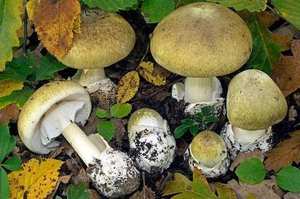
The Edible: Giant Puffball (Calvatia gigantea)
Giant puffballs are unmistakable when mature — white, smooth, and sometimes the size of a basketball. They're delicious when harvested young, sliced, and pan-fried. The safety rule is simple: slice the puffball in half from top to bottom before eating. A safe giant puffball is pure, uniform white throughout — no outlines, no shadows, no shapes inside.
The Look-Alike: Amanita Egg (Button-stage Amanita species)
Young Amanita mushrooms — including the deadly Amanita phalloides (Death Cap) and Amanita bisporigera (Destroying Angel) — emerge from the ground as white eggs before developing into their recognizable adult form. These eggs can superficially resemble small puffballs.
The slice test is definitive: an Amanita egg, when cut in half lengthwise, reveals the outline of a developing cap and gills inside the white flesh — like a mushroom in a snow globe. If you see any outline of a developing structure, discard immediately. The Death Cap contains enough amatoxin in a single cap to kill an adult.
4. Oyster Mushroom vs. Angel Wings
The Edible: Oyster Mushroom (Pleurotus ostreatus)
Oyster mushrooms grow in shelf-like clusters on dead or dying hardwood, with a broad, fan-shaped cap in shades of gray to cream to tan. They have a short, stubby, off-center stem. The flesh is firm and substantial, and the smell is mild and pleasant.
The Look-Alike: Angel Wings (Pleurocybella porrigens)
Angel wings are mildly toxic and have been linked to fatalities in Japan, particularly in individuals with kidney disease. They also grow on wood in clusters, but the differences are notable:
- Thickness: Angel wings are much thinner and more delicate — almost papery compared to the substantial flesh of an oyster mushroom.
- Stem: Angel wings have no true stem, or just a tiny nub. Oyster mushrooms have a definite stub stem.
- Host wood: Angel wings almost exclusively grow on conifer wood — spruce, fir, hemlock. Oyster mushrooms prefer hardwoods. Check your host tree.
- Color: Angel wings are pure white. Oyster mushrooms are usually grayish to tan, though white variants exist.
5. Chicken of the Woods vs. Similar Bracket Fungi
The Edible: Chicken of the Woods (Laetiporus sulphureus / L. cincinnatus)
Chicken of the woods is one of the easiest mushrooms to identify, thanks to its vivid coloring. It produces shelf-like brackets in bright orange and yellow — sometimes almost neon — on hardwood trees and stumps. The undersurface is covered in tiny pores, not gills. Young, tender outer edges are the best eating.
Similar Bracket Fungi
A few other bracket fungi could theoretically be confused with chicken of the woods by a very inexperienced forager:
- Sulfur shelf impostors: No true toxic look-alike exists in the Northeast, but older, faded specimens of chicken of the woods lose their vivid color and become pale. These are past their prime and unpleasant to eat, but not typically dangerous.
- Check the pore surface: Chicken of the woods always has a pore surface (tiny holes) on the underside — not gills. If you see gills, it's something else entirely.
- Note the host tree: Specimens growing on conifers, black locust, or Eucalyptus can cause reactions in some people even when the identification is correct. Stick to oak, cherry, and other common hardwoods when you're getting started.
Take Your Identification Skills Further
The five pairs above are the ones that cause the most confusion for new foragers in the Northeast. But the full look-alike landscape is broader — and the safest foragers are those who study systematically, not just reactively.
Our Edible vs. Toxic Look-Alike Reference Pack is a comprehensive field reference with side-by-side comparison charts for the most commonly confused pairs. Designed to be printed and carried, it's the reference you want in your pack before your next outing.
Browse the Store — Look-Alike Reference Pack
Join a growing community of mushroom foragers
Learn to identify what you pick before you eat it — share finds, ask questions, and forage with confidence alongside thousands of fellow hunters.
Join the Community