Edible Wild Mushrooms in Fall: 6 Species Worth Knowing
Fall is the most productive season for edible wild mushrooms across most of North America. The cooling temperatures, seasonal rainfall, and abundance of decaying and living wood create ideal conditions for a remarkable diversity of species. Here are six edible wild mushrooms worth learning before the season starts — with field ID notes, habitat clues, timing, and one critical safety point for each.
1. Golden Chanterelle (Cantharellus cibarius and related species)
ID Notes
Golden to egg-yolk yellow, with a wavy, lobed cap margin and a characteristic vase shape when mature. The defining feature: the underside bears false gills — blunt, forking ridges that are folds in the cap flesh itself, not separate structures. You cannot peel them away. The flesh throughout is firm and white when cut. The smell is fruity and apricot-like — once you've smelled it, you'll always recognize it.
Habitat & Timing
Grows singly or scattered from soil in mixed hardwood forests — oak, beech, birch — never from wood. Late July through October in the Northeast, with peak abundance in August and September after warm-weather rains.
Key Safety Note
The jack-o'-lantern mushroom (Omphalotus illudens) is the primary look-alike. It's toxic, bright orange, and has true gills (blade-like, separable from the cap). Jack-o'-lanterns also grow in clusters from wood or buried roots — chanterelles never do. Confirm false gills + solitary soil growth + fruity smell before harvesting.
2. Hen of the Woods / Maitake (Grifola frondosa)
ID Notes
A large, compound mushroom producing overlapping fan-shaped fronds in gray-brown tones with a white to cream pore surface below. The fronds emerge from a shared base, forming a rosette that can weigh two to fifteen pounds or more. The pore surface (tiny holes, no gills) is a key distinguishing feature.
Habitat & Timing
Grows at the base of mature oaks — almost exclusively — in eastern North America. Rarely found on other hardwoods. Returns to the same host tree year after year. Prime timing is September through mid-October; earlier in warm years. Once you find a productive oak, mark it and return annually.
Key Safety Note
The black-staining polypore (Meripilus sumstinei) grows in similar habit and can be confused with hen of the woods by beginners. Key tell: it stains black when the flesh is bruised or cut — hen of the woods does not. The black-staining polypore is generally considered edible but much inferior; the staining test keeps them separated.
3. Chicken of the Woods (Laetiporus sulphureus / L. cincinnatus)
ID Notes
Possibly the most visually striking mushroom in the Northeast. Chicken of the woods produces bright orange and yellow shelf-like brackets — sometimes almost neon — on hardwood trees and stumps. The underside has a dense layer of tiny pores (not gills). Young, tender outer edges have a mild, meaty flavor and firm texture that genuinely resembles chicken breast when cooked properly.
Habitat & Timing
Grows on dead, dying, or living hardwood — most commonly oak and cherry in the Northeast. Can appear from midsummer through fall; peak in August and September. The same host may produce for multiple years.
Key Safety Note
Chicken of the woods growing on black locust, conifer, or Eucalyptus has caused gastrointestinal reactions in some people even when correctly identified — the host tree seems to matter. Stick to oak, cherry, and maple, especially while getting started. Eat a small test portion the first time, as individual reactions vary.
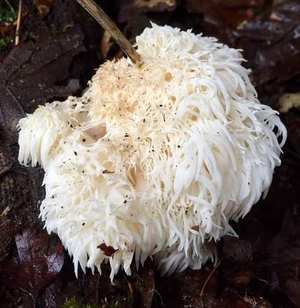
4. Lion's Mane (Hericium erinaceus)
ID Notes
One of the easiest mushrooms to identify with confidence — there is nothing else in the Northeast woods that looks like lion's mane. It produces a single, globular to irregular fruiting body covered in cascading white spines up to several inches long, growing from a single attachment point on hardwood. It has no cap, no gills, no stem in the conventional sense — just spines.
Habitat & Timing
Fruits from wounds or branch scars on living or recently dead hardwood — beech and oak are common hosts. Often grows high on the trunk, sometimes requiring binoculars to spot. September through November in the Northeast, with peak quality when the spines are white and firm. Yellowing spines indicate age and increasing bitterness.
Key Safety Note
No dangerous look-alikes exist in North America. However, quality matters — old or yellowed lion's mane becomes very bitter and unpleasant. Harvest only when the spines are pure white and the flesh is firm and dry. The flavor reward (mild, seafood-like) is worth seeking out young specimens.
5. Oyster Mushroom (Pleurotus ostreatus)
ID Notes
Fan-shaped to oyster-shaped caps in shades of gray, cream, or tan, growing in shelf-like overlapping clusters on dead or dying hardwood. The gills are white, run down a short, off-center stub stem, and are decurrent — they extend down the stem rather than stopping at the cap margin. The flesh is substantial and firm, and the smell is mild and pleasant.
Habitat & Timing
Grows on dead or dying hardwood — fallen logs, standing snags, dying elms and beeches are particularly favored. One of the most cold-tolerant edible mushrooms; can fruit after frost and persist into November or December in mild years. Oyster mushrooms are worth checking fallen logs in late fall when most other species have finished.
Key Safety Note
Angel wings (Pleurocybella porrigens) grow in similar overlapping clusters on wood, but are much thinner and more delicate, have no true stem, and grow almost exclusively on conifer wood. Oyster mushrooms grow on hardwood and have substantially more flesh. Check your host tree — hardwood vs. conifer — and note the flesh thickness before harvesting.
6. Giant Puffball (Calvatia gigantea)
ID Notes
A large, smooth, white sphere growing from the ground — sometimes baseball-sized, sometimes the size of a volleyball or larger. When fresh and ready to eat, the interior is pure, uniform white throughout, with the texture of firm marshmallow. As it matures, the interior turns yellow, then olive-green as it converts to a mass of dark spores. Only harvest and eat puffballs in the pure white stage.
Habitat & Timing
Found in meadows, fields, forest edges, and open woods — often in grassy areas near trees. August through October in the Northeast, with the best quality in September. Puffballs can appear suddenly after rains and mature quickly.
Key Safety Note
Always slice every puffball in half lengthwise before eating. This is non-negotiable. A young Amanita mushroom (including the deadly Death Cap and Destroying Angel) emerges from the ground as a white egg and can superficially resemble a small puffball. When sliced, the Amanita egg reveals the outline of a developing cap and gills inside. A safe giant puffball is pure, uniform white throughout with absolutely no internal structure visible. If you see any hint of an outline, any shadow, any developing form inside — discard the entire specimen and wash your hands.
Go Deeper This Fall
All six of the species above are covered in detail in our Fall Forager's Seasonal Planner — a printable field resource with month-by-month fruiting charts, habitat guides, and look-alike comparisons for the full fall season. Or if you want to focus specifically on the look-alike question (the single most important safety topic for any forager), the Spring Mushroom ID Cards cover spring species in printable field-card format.
Get the Fall Forager's Seasonal Planner — $15
Join a growing community of mushroom foragers
Learn to identify what you pick before you eat it — share finds, ask questions, and forage with confidence alongside thousands of fellow hunters.
Join the Community