Venom Classification Overview
Why Coral Snakes Are More Dangerous Than They Look
The deceptive calm: Coral snake envenomation is uniquely treacherous because the body gives almost no immediate warning signal. There is typically no significant pain, no swelling, and no dramatic local reaction at the bite site. A patient who felt a "scratch" or a "pinch" may feel completely normal for 1 to 13 hours — then deteriorate rapidly to respiratory failure.
Mechanism — irreversible post-synaptic blockade: Coral snake alpha-neurotoxins bind to nicotinic acetylcholine receptors at the neuromuscular junction. Unlike organophosphates or pre-synaptic toxins, this blockade is not easily reversed. Once binding is established, antivenom can only prevent further binding — it cannot displace toxin already on the receptor. Recovery ultimately depends on new receptor synthesis, which takes days to weeks. This is why antivenom must be given before neurological signs develop.
Descending paralysis pattern: Cranial nerves are affected first — ptosis (drooping eyelids) and diplopia are the earliest signs. This progresses to dysphagia (inability to swallow), dysarthria (slurred speech), and then respiratory muscle paralysis. Without mechanical ventilation, respiratory failure is fatal.
Clinical implications: Any suspected coral snake bite requires immediate transport to an emergency department capable of providing mechanical ventilation, regardless of symptom status. "I feel fine" is the expected presentation for hours and cannot be used to judge safety.
Species Clinical Reference Cards
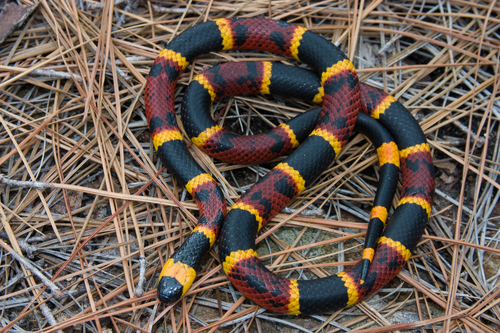
Eastern Coral Snake
Field Identification
- Red and yellow bands touch each other (key to rhyme)
- Black snout — head entirely black to behind eyes
- Round pupils — NOT elliptical
- Rounded, blunt head — NOT triangular
- Small fixed fangs at front of mouth (not hinged)
- Smooth, shiny scales; slender body
- Adults 20–30 inches; max ~47 inches
- Rhyme: "Red touches yellow, kills a fellow"
Clinical Presentation
- Minimal or no local pain at bite site
- Little or no swelling — absence is classic
- Delayed neurological onset: 1–13 hours
- Ptosis (drooping eyelids) — earliest sign
- Diplopia, blurred vision
- Dysphagia, dysarthria — progressing paralysis
- Generalized weakness, descending paralysis
- Respiratory failure — primary cause of death
Symptom Timeline — Delayed Onset
⚠️ Absence of symptoms does NOT indicate a dry bite. This timeline represents typical envenomation progression:
1–13 hours: Neurological onset begins — ptosis, drowsiness, weakness, diplopia
6–18 hours: Progressive dysphagia, dysarthria, generalized weakness
12–36 hours: Respiratory muscle failure — mechanical ventilation required
Recovery: Weeks to months if ventilated and supported — new ACh receptor synthesis
Field Response
✓ Do
- Call 911 immediately
- Remove jewelry and tight clothing
- Keep patient calm and still
- Note exact time of bite
- Transport to ER even if asymptomatic
- Call 1-800-222-1222
✗ Do Not
- Apply tourniquet
- Cut or suck the wound
- Apply ice
- Wait for symptoms — CRITICAL
- Assume dry bite if asymptomatic
- Let patient drive themselves
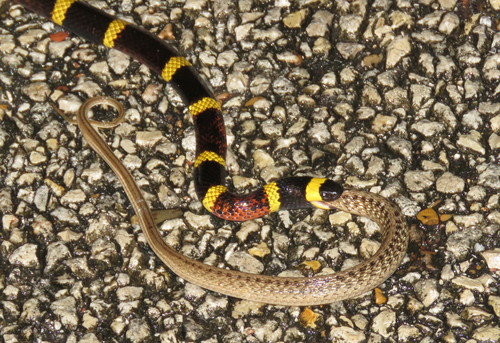
Texas Coral Snake
Field Identification
- Red and yellow bands touch — same rhyme as Eastern
- Black snout extending behind eyes
- Rounded head; round pupils
- Slightly smaller and more slender than Eastern
- Smooth shiny scales; secretive and fossorial
- Adults 20–24 inches; max ~36 inches
- Often confused with scarlet snake in TX range
Clinical Presentation
- Identical neurotoxic syndrome to Eastern Coral Snake
- Delayed onset 1–13 hours — same pattern
- Ptosis, diplopia earliest signs
- Dysphagia, dysarthria, generalized weakness
- Respiratory failure — primary mortality risk
- Potentially higher venom potency per mg than Eastern
- No approved antivenom specific to M. tener — Antivenin Micrurus fulvius used
Symptom Timeline — Delayed Onset
⚠️ Same delayed-onset pattern as Eastern Coral Snake. Do not use lack of symptoms to reassure patient or delay transport:
1–13 hours: Neurological onset — ptosis, drowsiness, diplopia
6–18 hours: Dysphagia, dysarthria, limb weakness progressing
12–36 hours: Respiratory failure — ICU admission and ventilator support required
Recovery: Prolonged — weeks of ventilatory support may be necessary
Field Response
✓ Do
- Call 911 immediately
- Remove jewelry and tight clothing
- Keep calm and limit movement
- Note exact time of bite
- Transport to ER even if asymptomatic
- Call Poison Control 1-800-222-1222 for antivenom location
✗ Do Not
- Apply tourniquet
- Cut or incise the wound
- Apply suction or ice
- Wait for symptoms — delay is deadly
- Drive to hospital alone
- Assume dry bite
Antivenom Dosing Protocol
North American Coral Snake Antivenom Dosing
Initial Dose
3–5 vials IV
Diluted in 250–500 mL normal saline
Infuse over 30–60 minutes with close monitoring
Start as early as possible — do not wait for symptoms
Repeat Dosing
Repeat 3–5 vials every 2 hours as needed based on neurological progression.
If ptosis, dysphagia, or weakness advances — redose.
Total doses guided by clinical response.
Administration
IV infusion only — NOT intramuscular.
Premedicate with diphenhydramine (consider epinephrine on hand for anaphylaxis).
Monitor for hypersensitivity reactions during infusion.
Timing Is Critical
Antivenom must be given BEFORE established neurological deficit. Once alpha-neurotoxins bind to ACh receptors, antivenom cannot reverse the block. Treat on suspicion — do not wait to confirm symptoms before administering.
Full Field Do / Do Not — Coral Snake Specific
Coral Snake Field Response Protocol
⚠️ Critical difference from pit vipers: Seek care immediately regardless of symptoms. Delayed onset is NOT a sign of safety.
✓ Do
- Call 911 immediately — do not wait for symptoms to appear
- Remove jewelry, watches, rings, bracelets near bite site
- Remove tight clothing near bite area
- Keep the patient calm and as still as possible
- Note the exact time of the bite
- Call Poison Control: 1-800-222-1222
- Get to an emergency room even if completely asymptomatic
- Tell ER staff it is a suspected coral snake bite immediately on arrival
- Request antivenom location check via Poison Control
- Prepare for possible respiratory support — inform receiving ER
- Photograph the snake from a safe distance if possible
✗ Do Not
- Apply a tourniquet or constricting band
- Cut or incise the bite wound
- Attempt to suck out venom by mouth or device
- Apply ice, cold water, or cold compress
- Wait for symptoms before seeking care — this is the most dangerous mistake
- Assume "dry bite" because there is no pain or swelling
- Allow patient to drive themselves to hospital
- Give food, water, alcohol, or medication
- Use electric shock (no evidence, dangerous)
- Handle or attempt to capture the snake
- Discharge patient from observation within 24 hours
Myth Busting Table
The Rhyme, Its Limits, and Common Confusions
| Myth / Claim | Status | Reality |
|---|---|---|
| "Red touches yellow, kills a fellow" always works | ⚠ Partial | Accurate for US coral snakes only. Completely fails for non-US Micrurus species (Central/South America, Asia, Africa). Do not use abroad. |
| The rhyme works in all of Florida | ⚠ Exceptions | Florida Scarlet Snake (Cemophora coccinea) and Scarlet Kingsnake (Lampropeltis elapsoides) in FL have red-yellow-black banding that can confuse inexperienced observers. In south FL, geographic variation in some harmless species can challenge the rhyme. |
| Southern Milk Snake looks nothing like a coral snake | False | Southern Milk Snake (Lampropeltis triangulum syspila) has red-black-yellow banding; in its range the rhyme (red touches black, not yellow) correctly identifies it as harmless — but inexperienced foragers may still hesitate. |
| No pain/swelling = dry bite, safe to observe at home | False — Dangerous | Coral snake envenomation classically produces minimal local reaction. Absent symptoms for 1–13 hours is the normal onset pattern, not evidence of a dry bite. All suspected bites require ER evaluation. |
| Small snake = small risk | False | Coral snakes are 18–30 inches on average — small-looking. But their venom is among the most potent of North American species per mg. Size does not predict danger. |
| Coral snakes are aggressive | False | Coral snakes are secretive and typically non-aggressive. Most bites occur when someone reaches under bark, logs, or leaf litter, or handles the snake. They do not actively pursue people. |
| The rhyme distinguishes all red-banded US snakes | Oversimplified | Scarlet Kingsnake, Scarlet Snake, and Milk Snake all occur in coral snake range. When in doubt: do not handle. The rhyme is a field guide approximation, not a clinical tool. |
| Antivenom is always available at US emergency rooms | False | Wyeth production has ceased. Stockpiles are regional and finite. Many hospitals do not stock coral snake antivenom. Always call Poison Control immediately to locate supply before transport. |
Forager Encounter Scenarios by Terrain
🌿 Southeast Swamp & Pine Flatwoods
The Eastern Coral Snake's core habitat. Foragers collecting chanterelles, blueberries, wild muscadines, or palmetto berries move through exactly the microhabitats coral snakes favor.
- Found under rotting logs — common foraging sites
- Under bark slabs, leaf litter, and wood piles
- Active during cooler morning hours and dusk
- Often buried just under soil surface in sandy areas
- Frequently encountered when moving debris or turning logs for mushrooms
- Fossorial — may be hidden directly beneath your hand
🌵 Texas Brush Country & Cedar Breaks
Texas Coral Snake habitat. Foragers harvesting dewberries, agarita berries, hen of the woods, or morels near river floodplains and rocky cedar hillsides.
- Under flat limestone rocks and cedar bark — prime habitat
- Sandy soil along creek and river margins
- Often found while moving rocks for camp fire rings
- Active in spring and fall; may aestivate in summer
- Colorful appearance sometimes leads foragers to pick them up
- Confused with Scarlet Snake in east TX range
⚠ High-Risk Forager Behaviors
These specific actions account for the majority of coral snake bites in foraging and outdoor recreation contexts:
- Reaching bare-handed under logs and bark
- Picking up what looks like a colorful stick or rope
- Moving through dense palmetto or undergrowth
- Handling a coral snake that appears dead — post-mortem envenomation documented
- Allowing children to pick up "pretty" snakes without adult identification
- Foraging barefoot or in sandals in SE coastal plain
🛡 Prevention in Coral Snake Country
Simple behavioral modifications eliminate most coral snake bite risk for foragers:
- Use a stick or tool to flip logs and bark — never bare hands
- Wear leather gloves when moving debris
- Wear closed-toe shoes and long pants in flatwoods and scrub
- Do not pick up any unfamiliar snake regardless of rhyme confidence
- Teach children "look but never touch any snake"
- Carry Poison Control number: 1-800-222-1222
Veterinary Reference — Dogs & Cats
Coral Snake Envenomation in Pets
Dogs and cats that encounter coral snakes in the Southeast and Texas are at significant risk. Their smaller body mass relative to venom dose accelerates neurotoxic kinetics compared to adult humans.
Onset in small animals: Neurological signs may appear within 30 minutes to 2 hours post-bite — significantly faster than the 1–13 hour window in humans. Do not wait for symptoms before seeking veterinary emergency care.
Clinical signs in dogs and cats:
- ▸ Progressive hind-limb weakness and ataxia
- ▸ Muscle tremors and twitching
- ▸ Ascending or descending paralysis
- ▸ Inability to hold head up
- ▸ Respiratory distress — open-mouth breathing, extended neck posture
- ▸ Dilated pupils
Treatment: There is no commercially available veterinary antivenom for US coral snake envenomation. Treatment is supportive — oxygen supplementation, mechanical ventilation if available, sedation. Prognosis is poor without aggressive respiratory support.
Transport immediately to a veterinary emergency hospital. Do not wait for symptom progression.