The False Ones: Look-Alikes Worth Knowing
The mushrooms that hurt people almost never look completely different from the safe ones. They look close enough to be mistaken for them. Here are four pairs worth learning cold — not to make you afraid of the woods, but to sharpen exactly what you check before anything goes in a basket.
Most people picture mushroom poisoning as an obscure toxic species nobody's ever heard of, growing somewhere off the beaten path, easy to avoid if you just stick to the "known" ones. That's not really how it happens. The mushrooms that put people in the hospital are usually standing right next to, or growing in the same patch as, something perfectly edible — close enough in size, shape, and color that a quick glance genuinely can't tell them apart. The danger isn't a mystery species. It's mimicry. Our tier system tells you how serious a species is once you've identified it correctly. This article is about the moment before that — the actual look, side by side, that separates a safe mushroom from its dangerous double.
Four pairs, in order of how often they come up and how much they matter. For each one: why someone would mix them up, and then the specific, concrete things that actually tell them apart — not vague impressions, but gill color, veil remnants, spore print, smell, and the shape of the base. Slow down at the base of every mushroom on this list. That's where three of these four pairs are actually decided.
1. Death Cap vs. Edible Parasols (and Paddy Straw Mushroom)
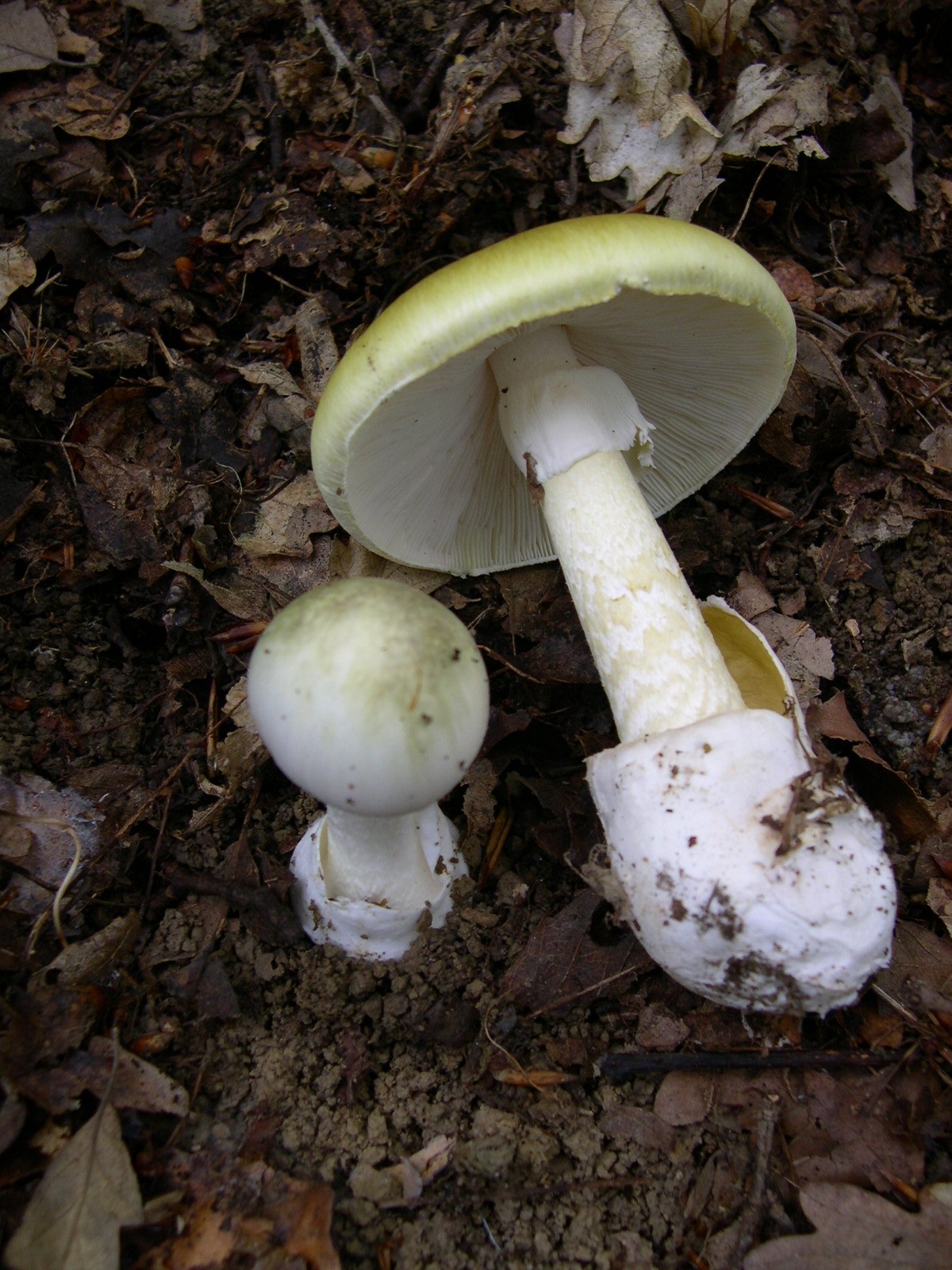
Why they get confused: the death cap is a pale, unremarkable-looking mushroom — nothing about it screams "deadly" the way a bright red toadstool might. At a glance, a young death cap has the same general silhouette as an edible parasol mushroom (Macrolepiota procera) or the shaggy parasol: a smooth, roundish cap on a fairly plain white-ish stem, growing out of the ground in the same kind of habitat, sometimes in the same season. The paddy straw mushroom, an edible species popular in parts of Asia, shares that same basic "plain pale cap on a stem" profile before it's opened up and looked at closely. This is exactly the mistake we walked through in Blinded by Experience — a forager with twenty years of picking parasols clean stopped checking the one feature that would have caught it.
The tells:
- Dig up the base and look for a cup. This is the single most important check on this entire list. The death cap has a white, sac-like cup (called a volva) buried at the base of the stem, often hidden just under the soil surface. Edible parasols don't have this at all — the stem just tapers to a point or a slight bulb, no cup. If you're not willing to dig up the base and look, don't eat the mushroom. Full stop.
- Gill color and attachment. Death cap gills are free (not attached to the stem) and white, staying white as the mushroom matures. That alone won't separate it from a parasol, which is also usually pale-gilled — which is exactly why the base check matters more here than gill color does.
- Spore print. White, for both the death cap and edible parasols — this pair is one where spore print color does not help you, which is part of why it's so dangerous. Don't rely on spore print alone for this one; rely on the base.
- Ring on the stem. The death cap has a skirt-like ring partway up the stem. Edible parasols usually have one too, sometimes a double ring that can slide up and down the stem freely (a genuinely useful feature on true parasols) — so the ring alone is a supporting detail, not the decision.
- Cap color. Death cap caps run pale green to yellow-green, sometimes fading to a dull white with age — that greenish tint, when present, is a real warning sign, but older or faded caps can look nearly white, which is exactly why you can't rely on color alone.
- Smell. Little to none when fresh. Don't expect an obvious warning here.
The short version, and the one worth memorizing: no edible parasol has a volva cup at the base. If there's a cup, it's not a parasol, and it doesn't matter how much the rest of it looks right.
2. Destroying Angel vs. Common Button-Style Mushrooms
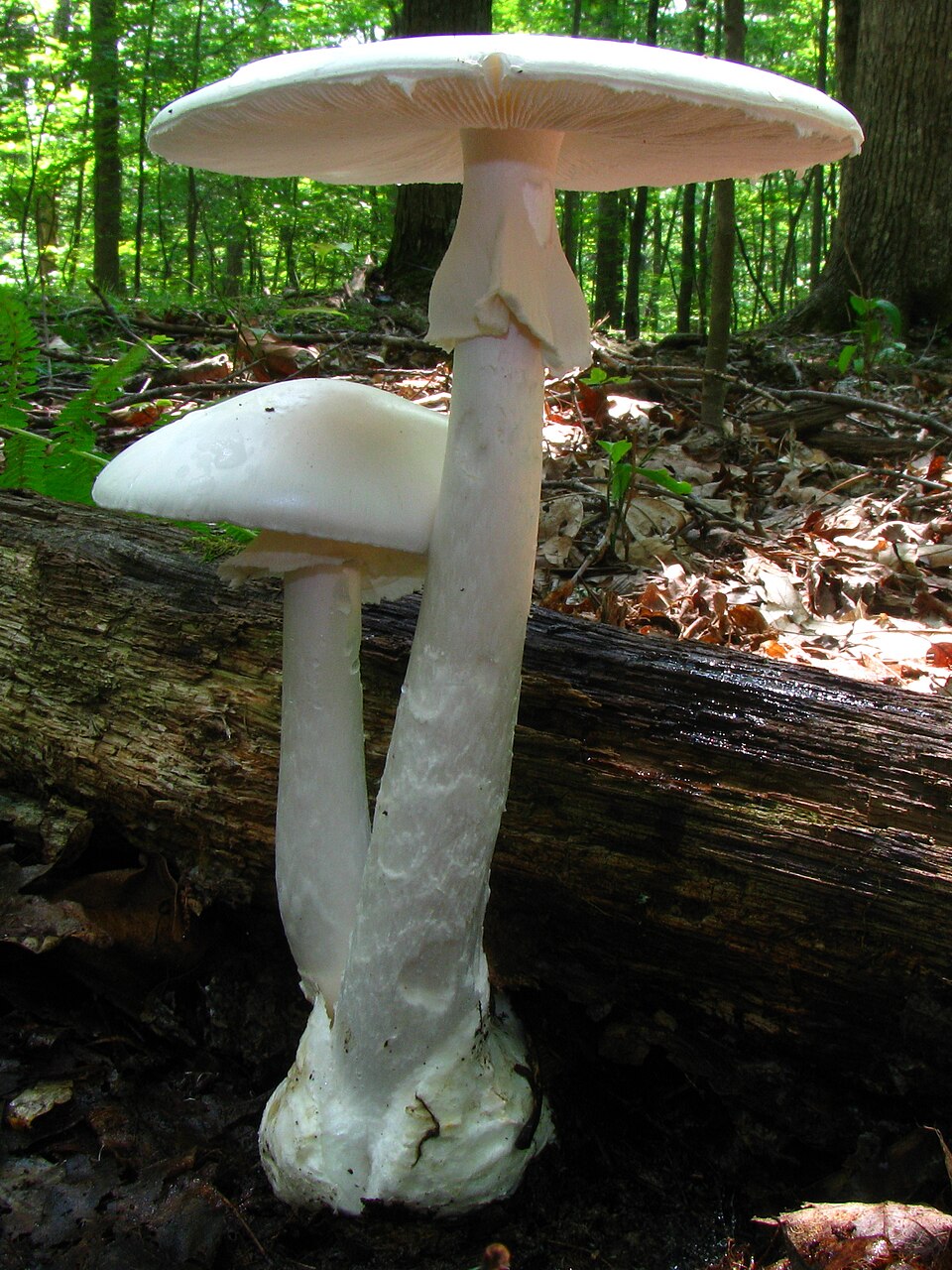
Why they get confused: the destroying angel is the death cap's pure-white North American relative, and "pure white and unremarkable" is exactly the description of a common white button mushroom (Agaricus bisporus) picked up from a store, or the wild white puffball buttons foragers dig for in fields and lawns. A young destroying angel, still egg-shaped and unopened, can look almost identical to a puffball button from the outside — and a mature one, opened up, looks like an ordinary all-white mushroom cap on a stem, the same general impression as a store-bought button mushroom sitting on a plate.
The tells:
- Cut every round white button in half before deciding anything. This is the puffball rule, and it's non-negotiable: a genuine puffball is pure white and featureless all the way through when sliced open, like a marshmallow. If you cut one open and see any outline of a cap, gills, or a stem forming inside, you're not holding a puffball — you're holding an unopened destroying angel (or death cap) button, and it's deadly.
- Gill color. Destroying angel gills are white and stay white. Store-bought button mushrooms (Agaricus bisporus) start out pale pink and darken to brown or near-black as they mature — a color change the destroying angel never does. If the gills are pink, tan, or brown at any stage, it isn't a destroying angel. If they're pure white at every stage, don't relax — check the base.
- The base, again. Just like the death cap, the destroying angel has a white volva cup at the base of the stem. A button mushroom's stem base is solid, tapered, with no cup at all. Dig it up and look every single time.
- Ring on the stem. Destroying angel has a skirt-like ring; store-bought buttons typically have a much thinner, less obvious ring or none at all depending on maturity.
- Spore print. White for the destroying angel. Brown to dark brown for a mature Agaricus button — a genuinely useful difference here, unlike the death cap/parasol pair. If you have any doubt and time to wait a few hours, a spore print on a mature specimen is worth taking.
- Smell. A faint, almost honey-like smell when fresh that can turn unpleasant as the mushroom ages — not a reliable warning sign on its own, but worth noting.
Everything about the destroying angel is white — cap, gills, stem, ring, volva — which is exactly what makes it so easy to wave off as "just a plain white mushroom." Plain and safe are not the same thing. Cut it open, dig up the base, and check the gill color before deciding either way.
3. False Morels vs. True Morels
Why they get confused: both fruit at almost exactly the same time in spring, often in the same general habitat, and both have an irregular, non-smooth cap that doesn't look like a typical round mushroom cap — which is precisely why a beginner scanning the forest floor for "that weird bumpy mushroom" can grab either one without immediately noticing a difference. True morels are prized and widely hunted; false morels get picked up right alongside them by people who haven't learned the one test that actually separates them.
The tells:
- Cap texture. A true morel's cap has a genuine honeycomb pattern — distinct pits and ridges forming a lattice all over the surface, evenly and consistently. A false morel's cap is wrinkled, lobed, and folded, more like a brain or a saddle than a honeycomb — irregular rather than a consistent pitted grid.
- Slice it in half, top to bottom. This is the single test that matters most here. A true morel is completely hollow — one continuous open cavity running from the tip of the cap down through the stem, nothing inside at all. A false morel is not fully hollow. Cut one open and you'll find internal chambers, folds, or a cottony, fibrous filler tissue instead of a clean open cavity. If it's hollow all the way through, that's a true morel. If there's anything inside, walk away.
- How the cap attaches to the stem. A true morel's cap is attached to the stem along its full length, from the top of the stem down to where the cap flares out — it reads as one continuous piece. A false morel's cap often hangs free, attached to the stem only near the very top, like a cap draped loosely over a stalk rather than fused to it.
- Color and shape. False morels tend to run more reddish-brown, with a rounder, saddle- or brain-like lobed shape. True morels run cream, tan, or golden-yellow, with a more elongated, conical overall shape.
When in doubt, the slice test settles it every time: hollow all the way through, cap to stem, means true morel. Anything else — chambers, folds, filler — means false morel, and it stays in the woods.
4. Green-Gilled Parasol vs. Safe Parasols
Why they get confused: the green-gilled parasol (Chlorophyllum molybdites) is, by size and silhouette, one of the most convincing edible-parasol mimics there is — large, white, scaly-capped, with a prominent ring, growing in lawns and open grassy areas after summer rain, the exact habitat and general look of the true edible parasol and the shaggy parasol. It's also one of the most commonly reported toxic mushroom calls to poison centers in the country, precisely because it grows somewhere so ordinary — a suburban lawn, not a remote patch of woods — that people pick it with less caution than they'd use deep in the forest. This is the exact species behind The Second Thought, where a forager made a reasonable field call on a promising parasol and only caught the mistake after the fact.
The tells:
- Gill color as it matures — the single most reliable check. A young green-gilled parasol starts out with white gills, same as a true edible parasol. But as it matures, the gills turn a distinct dull green — and that color change is the giveaway. If you see any greenish tint developing in the gills, especially in an older specimen, that's your answer.
- Spore print — the definitive test. This is the one piece of information worth waiting a few hours for. Green-gilled parasol has a green spore print. No edible parasol has a green spore print — true and shaggy parasols both print white. If you take a spore print and see any green in it, it's not a safe parasol, no matter how good the rest of it looks.
- Don't rely on cap scales, ring, or overall size alone. All three — the brownish scaly cap surface, the double ring, and the overall large size — are shared between the toxic and edible species. None of them separate this pair reliably on their own; they're what makes the mix-up so easy in the first place.
- Symptom timing, after the fact. Not a field ID tool, but worth knowing: green-gilled parasol causes fast-onset gastrointestinal illness, usually within 1–3 hours of eating it — explosive nausea, vomiting, and watery to bloody diarrhea. That's meaningfully different from an amatoxin species like the death cap, which can take 6 hours or more to show anything at all. Fast, severe GI symptoms after eating a "parasol" points toward this species rather than an amatoxin exposure — useful information for whoever you call, not a substitute for calling them.
The rule for any large white or pale scaly-capped mushroom growing in grass: take a spore print before you eat any of it. It costs you a few hours of waiting. Green means don't. White means it cleared the one test that actually matters here.
A note on how this gets written: this article, like the rest of our field notes, was drafted with AI assistance and reviewed by our team before it went up. The photo above of the death cap is a real, verified photograph — not an illustration. We didn't include photos for the other three pairs because we don't yet have verified reference photos of our own for them on file, and we'd rather show nothing than show something that could be mistaken for a real identification reference.